“Are you proud?”

I was doing my best to be a badass. It was working pretty good. Well, it was working well enough to keep second graders in line at their fine arts visit to the university. It was the class of second graders that my eldest daughter teaches. I walked across campus on a brisk, cloudy morning to help corral and keep the kids in line. A job right up my alley? Perhaps.

For you folks with no experience in the art of elementary school field trip duty, let me tell you a 30 minutes cello + piano concert is an amazing cultural opportunity for these kids, but…it is not the easiest thing to get an auditorium full of 8 & 9-year-olds to behave and listen to a 30-minute cello + piano recital. Not an easy thing at all.

The kids were awesome! They paid attention and listened; really listened to the music. I only had to pull out the Coach Hays death glare a couple of times and even had a productive discussion with the supposed “naughtiest” kid in the class who I had the pleasure to sit next to.

After the show, the class waited for their bus to arrive on the sidewalk outside the venue. Classic elementary school style of single file line order. My daughter leads the line and my job is to bring up the rear and not to lose any kids. The precision spacing and order of the line begins to break down as soon as we quit walking and start waiting. Kids start nervously moving around and telling “interesting” stories about their cat, their little brother, or their mother’s current boyfriend. Herding goats is actually easier to keeping these kids in alignment, but we survived.

A group of girls drifts back to the end of the line and the spokesperson of the group slides over until she is standing directly in front of me. She looks up with an angelic, second-grader face and asks, “Are Ms. Hays’s dad?”

“Yes.” I begin to wonder where this is going as the throng of girls collectively inch closer.

“Mr. Hays, are you proud of her?”

BANG!

I was stopped in my tracks. My badass failed me. My cold heart melted.

Yes. I am extremely proud of my kids. One teacher and, in a week, two college graduates. I am beyond proud the way they’ve started their lives outside the nest.

“Yes, I am.” was my simple answer. Three words that easily could have blown up into a thousand words (and possibly with colorful language not appropriate for second-grade ears). The little girl’s face lit up and her smile almost made me break down in tears. The bus soon came and I said goodbye to all my second-grade friends.

As I walked across campus a proud dad, I hoped each of the little girls, and the rest of the kids in the class, had someone in their life to be proud of them. I wished the people in these kid’s lives appreciated their potential and will help them grow into something they can take great pride in.

It’s a great feeling having kids turning into adults, especially when they are turning into much better adults than their “badass” old man.

It feels kind of like…

WorldSeriesTrophyKSU

Every single day.


Leave a comment

Filed under Rants, Writes

Getting Technical

I read an article about a 6’ 8” college basketball player who decided this spring to switch and play football at the same college. The football coaches were working to refine his big man basketball skills toward the goal of being an offensive tackle. It was a very interesting article and kind of reinforced my belief there are certain common physical movements which exist between sports.

The head football coach made a comment that the staff didn’t mind working with such a green athletes because many of their actual football recruits also show up with no, or very little, fundamental technical skill from the high school level. I about choked. It made me mad at first, but then I remembered how many times over the past five or so years I’ve noticed this lack of fundamentals in action at high school football games I’ve watched.

How can this be? Is teaching solid technical proficiency becoming a lost coaching art?

Fundamental technique is the building block on which winning programs are built. In baseball and football coaching, everything, for me, revolved around developing solid technical skills. Being sound technical offensive and defensive linemen allowed us to overcome a general lack of size, speed, and athleticism in order to compete almost every time we stepped on the field.

Years ago, one rival baseball coach asked me once how it was that our kids all seemed to be able to drive the ball on the line to all fields. I told him the truth. I told him we teach front-hand hitting technique and every, single thing we do in practice, in the cage and on the field is geared toward developing a consistent technical swing. He looked at me like I was nuts, shook his head and laughed as he walked back to his dugout.

At football coaching clinics, I always got a kick out of the “progressive” coaches who talked nothing but schemes and theories while laughing behind the old, highly successful coaches who talked about fundamentals and drills and perfection. Simple science.

By Snyder, Frank R. Flickr: Miami U. Libraries - Digital Collections [No restrictions or Public domain], via Wikimedia Commons

By Snyder, Frank R. Flickr: Miami U. Libraries – Digital Collections [No restrictions or Public domain], via Wikimedia Commons

Perhaps it is too simple for some to understand.

It is not magic.

It is not simply innate ability.

It is hard work. And teaching. And holding the line. And being strict. And demanding. And sometimes being completely unlikeable to the players.

It is pushing to get better every day.

Technique matters. It’s not sexy or shiny or going to make a big splash, but…

Technique matters.

It gives you an advantage. Good fundamental technique and good preparation give the advantage of an extra step. In sports, even at the lowly high school level, this single step can be the difference between winning and losing. Being fundamentally sound gives your team the edge over an opponent of equal or lesser quality and levels the playing field somewhat against a superior opponent.

Make the commitment. Get technical and get better.

By Royalbroil (Own work) [CC BY-SA 3.0 (http://creativecommons.org/licenses/by-sa/3.0)], via Wikimedia Commons

By Royalbroil (Own work) [CC BY-SA 3.0 (http://creativecommons.org/licenses/by-sa/3.0)%5D, via Wikimedia Commons

Leave a comment

Filed under Coaching, Training

Socialing

Athletes are, and should be, held to a higher standard. It is a price to be paid for the opportunity to participate. You, as an athlete, a coach, or a fan, owe the game much, much more than the game will ever owe you. As Coach Lane used to say, “Faith, family, and football is a game we are fortunate enough to be able to play.”

There are few areas where the modern athletes, especially the young, high school athlete, must hold themselves accountable to a higher standard than in the realm of social media. The ability to send our thoughts and ideas into the public realm is greater than it has ever been in the history of mankind. It’s instantaneous. It’s far-reaching. It can be a slippery slope.

Social media is great because it connects us like we have never been connected before and gives us an audience. Social media is bad because it connects us like we have never been connected before and gives us an audience. In short, social media is a double-edged sword. It can been used in a positive manner as easily as it can be used as a negative.

Parents, coaches and administrators need to develop a social media plan and convince players and teammates to abide by the plan. Creating the best tribe possible should be the underlying goal of everything we do as coaches and athletes. Social media is part of being in the tribe. Three things to remember about being a good tribe teammate.

  • What is good for the tribe is good for you too.
  • The jabs you take at the tribe are as damaging and as senseless as punching your own self.
  • Impact your tribe positively with your actions. In Coach Hays words, don’t crap in your own nest.

Social media is permanent. Your post is given a life. Your friends and followers see it. They like it or share it and your post is opened up to all the friends and followers of your friends and followers. The social reach can be extended to layer upon layer upon layer—even if you deleted your original post 30 seconds after posting it. Social media has permanence.

A good guidepost for social media, which is also a good guidepost for general life, is to not say anything to someone on social media or about someone on social media that you would not say if you were standing face to face to them.

Be true.

Be honest.

Be real.

But do it while playing nice.

Use your social media spectrum for good. The Mrs. Coach Hays, in her infinite wisdom on such matters dealing with young people, often reminds me of the credo, “Positive in public, negative on your own time.”

Be who you are, but put your best face toward the rest of humanity.

Finally, as the venerable Coach Melvin Cales used to tell his son and my college roommate, Monty, after Sunday visits to our college town where Coach Cales’s mother lived, “Don’t do anything you wouldn’t want your grandmother to read about in the paper.”

A great lesson to guide your social footprint.

And a great life lesson to boot.

Social wise, my friends. 

Socialmedia-pm

By Ibrahim.ID [CC BY-SA 4.0 (http://creativecommons.org/licenses/by-sa/4.0)%5D, via Wikimedia Commons

Leave a comment

Filed under Coaching, Rants

It’s Only JV

I left the house with purpose of mind. As soon as the local high school baseball practice was over, I’d jump on the field, rake the pitcher’s mound, rake the batter’s box, drag the field for tomorrow’s home JV baseball game, and get home in time to eat dinner with my wife. Thirty minutes…tops. Life has been a little crazy lately so I thought nobody would really mind if we just did the basic field prep work and went home. I told myself it was only a JV game. Get the field playable and forget all the bells and whistles of a normal varsity home game.

We finished the mound. We finished the batter’s box. I ran the finish drag around with the mower while RC hand-watered the pitcher’s mound and batter’s box. Well, it was only a JV game. 90-minutes later, I am raking the limestone track around the backstop with the new sprinkler laying down a fine spray of water on the dry-as-a-bone dirt and I pause to look at my watch. 90-minutes. Yeah, I missed dinner with my poor wife.

I continued to rake until everything was in its pre-game place.

I know it’s only JV game, but there is no “only”.

Every game matters. Every game is important.

A game deserves the very best of what we can give.

Every play, every pitch, every possession.

Life is like a JV game. It’s not often in the spotlight. It is not all glory. It is work. It is getting better every minute of every day. It is giving your best even though the crowd is small and nobody seems to really be paying attention.

This environment is where you get better. Get better at your game, your art, your career, your very human-ness.

Put your time in. Do your very best. And then wake up and do your very best tomorrow.

Hard work is the magic.

IMG_2900

Leave a comment

Filed under Uncategorized

Coach Wilson

I pulled an old t-shirt from the drawer to wear for our walk last night. It was one brought forth from the deepest, forgotten bottom of my shirt drawer. It brought a smile to my face and unleashed a flood of good memory of my all-time favorite sports mom. Here’s the shirt.

IMG_2889

When the kids were young and we had just moved to town—way before there even was a Coach Hays—we got involved with the local swim club. The future, great sports mom had a son a few years older than my kids, so, our first summer we crossed paths almost every weekend. Apparently, I wore a “Wilson” t-shirt quite often because toward the end of the summer, when we formally met the future great sports mom and her family, she told us a funny story about how she thought my last name was “Wilson” because that was the name on my shirt. We had a great laugh at the time and she continued to call me “Mr. Wilson” for years.

Fast forward to my first year of coaching football and her son is now a high school junior. Naturally, to the great sports mom, my title changed from “Mr. Wilson” to “Coach Wilson”. The name changed but not the ornery twinkle in her eye and smile whenever she called me that.

She was everything a sports mom should be.

  • Supportive of us coaches
  • Supportive of the other players.
  • Her son’s biggest fan, not his agent or his lawyer.
  • Never tried to pave the way to make things easy for her son.
  • Didn’t bring snacks/refreshments with the expectation her son should play because she brought snacks/refreshments.

Most importantly, she realized sports are just sports. She taught and valued the big picture and that there was more to life than a high school athletic career.

She was the kind of person you’d be happy to go out of your way for. Whether it was spending extra time with her son training or practicing or driving four hours after oral surgery in the middle of our family vacation to watch her son play the Kansas Shrine Bowl football game in 110° weather, you’d do it. But, I could never have told her “no” that particular time because she printed my entire family personalized Shrine Bowl t-shirts just so we could be a part of their family cheering section.

She passed away a few years ago. I miss this great sports mom. Whenever I see her son and the wonderful family he and his wife are growing, I am reminded of her joy, her kindness, and her fabulous attitude toward life. This helps fill some of the hole left from losing great people. Over the past several years, two of my favorite sports mothers have died too young. These ladies and the examples they set are greatly missed.

But, most of all, I miss being called Coach Wilson.


Leave a comment

Filed under Coaching

Under Your Skin

(This is my 350th post on The Coach Hays blog since I first started this dog and pony show in 2009. To celebrate, I thought a proper rant would be fitting. Thanks for reading and I hope I can keep going for at least 350 more.)

What makes a good athlete? What makes a team successful?

It’s about commitment. It’s about grinding through the work and the repetition. It’s the footwork drills. It’s the extra swings. It’s taking the shots after practice or perfecting your jump technique.

It’s going beyond what the practice and game plans say you should do. It is going beyond what your supporters say and further than your biggest detractors could ever dream was possible.

It’s the competitor’s mark to be permanently worn under your skin.

It’s a mark you wear with pride. As an individual. As a competitor. As a group. As a team. As a family.

  • Not a hashtag.
  • Not a poster hanging on the wall.
  • Not a program t-shirt.

The mark of a winner is burned on your heart. It seeps into every nook and cranny of your competitor spirit.

You do the work necessary. And then you do it again.

Look in the mirror. What do you see? If you don’t like the results you are reaping, look at what you are sowing.

  • Are you putting in the work? Input = Output.
  • Are you blaming instead of improving?
  • Talking instead of performing?
  • Whining instead of winning?

If you don’t like where you’re at, then take the steps to move forward. Sow the good seed.

Ask yourself, “Am I along for the ride or am I going to put this team on my shoulders and rise to the top?”

Commit. Improve. Do the work.

Hard work is the magic.

Wear the mark of a competitor. Decide if your mark is a temporary tattoo or if is it written in your marrow.

Be dependable. Be consistent. Be a rock.

Wear your commitment under your skin. As I’ve said before, Be Indelible.

Permanent and unshakeable. 

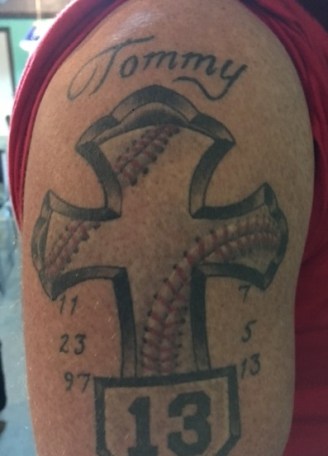
TLWtattoo

Photo used with permission. #TLW13

Leave a comment

Filed under Coaching, Rants, Training

Bits & Pieces

I was listening to sports radio today and heard a story about Cam Newton, the quarterback of the Carolina Panthers. After hearing the story, I was shocked at my initial reaction. The story was about Cam Newton saying, “I’m an African-American quarterback that may scare a lot of people because they haven’t seen nothing they can compare me to.”

Now, now…don’t jump to conclusions. I didn’t think anything negative about the Carolina Panthers QB. I like him and the energy and joy he brings to the game.

What jumped into my 51-and-a-half, grumpy-old-white-guy head was, “That’s right, Cam Newton is black, isn’t he.” What surprised me was that, as a bona fide, 51-and-a-half, grumpy-old-white-guy, I just see Cam Newton as a QB.

Have we progressed to the point where—for most of the NFL football fans in America—race  is beginning to matter less and less? But, race still matters and race should be celebrated instead of targeted with those unfounded stereotypes.

Hopefully, we are getting to the point where, thanks to guys like Marlin Briscoe, James Harris, Doug William, Randall Cunningham, Warren Moon, etc., we can finally bury the belief that it is not “normal” for an African American to play QB.

I wonder if we are re-defining what “normal” means?

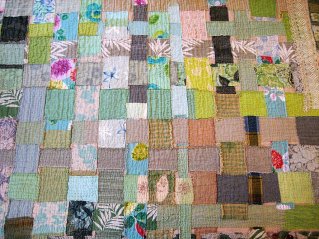
What is “normal”, anyway? Is there even a normal in America anymore? Not the “normal” that is built on stereotypes. Maybe normal has become a patchwork of bits and pieces. Maybe normal is made up of many facets that shine from different angles and radiate many colors. Maybe, just maybe, things are changing for the better.

The day when old, grumpy, white guy sees an African American QB as just a QB, it is good news. It is a sign of progress. It’s a better place to be where things like skin color matter less than action and deed.

Bits and pieces bound together to make the world a better place.

We are, in fact, made of bits and pieces of damn good stuff.

We are a patchwork of awesome.

Quilt_weaving_close_up

Leave a comment

Filed under Rants

2015 in review

The WordPress.com stats helper monkeys prepared a 2015 annual report for this blog.

Here’s an excerpt:

The concert hall at the Sydney Opera House holds 2,700 people. This blog was viewed about 10,000 times in 2015. If it were a concert at Sydney Opera House, it would take about 4 sold-out performances for that many people to see it.

Click here to see the complete report.

Leave a comment

Filed under Uncategorized

Crash Course

Bowl Week. It brings a smile to virtually every football fan’s face.  Four, or more, games a day. Teams and bowl games one has rarely heard of before. A football dream (at least to me).

But Bowl Week is more than just non-stop, sports television excitement. It is a chance for a coach to get a crash course in football. During the course of 10-14 days, a coach can watch and study virtually every offensive scheme out there pitted against virtually every defensive scheme in play.

Bowl Week is an excellent opportunity to expand the knowledge base. I don’t quite invest the time, or experience the temporary thumb paralysis from rewinding and rewinding the video with the remote control, as I used to when I was actively coaching, but I still love to watch these college football matchups in order to learn more about the game.

Most of us have heard the old adage, “If you aren’t getting better, you’re falling behind.”. A big chunk of that getting better occurs in the offseason—even for the coach. The players get better by training, by playing other sports, and working toward being better each and every day. Coaches need to do get better in the offseason also. No, take that back. Coaches don’t need to get better in the offseason, coaches must get better in the offseason. After taking a few weeks off at the end of their team’s season, a coach needs to start the process of self-improvement. Bowl Week gives us that opportunity.

I can watch the fast-break, spread offenses, flexbone veer offenses, two-back sets, one-back sets, empty sets and full-house sets all run in unique ways. I can learn how teams use motion to give the QB a coverage read. I can study what these QBs are reading and learn to recognize calls and route combinations. A good defensive coach learns to watch offenses, identify what they are doing and why, and then incorporate that knowledge into your own defensive scheme.

One of my favorite things is to study blocking schemes of all the offensive philosophies and schemes. Two of our most successful specialized blocking schemes were the reverse blocking and the screen blocking. Both came directly from watching college bowl games. The reverse blocking scheme was taken from Glen Mason’s Minnesota Golden Gophers team in the 2003 Sun Bowl and the screen blocking, if I remember right, was from a mid-2000’s Jim Tressel Ohio State bowl game.

Bowl Week. Watch your favorite teams play as a fan, but watch as many of the other games with the eye of a coach.

Always get better.

Your players need it.

Your players deserve it.

IMG_2636

1 Comment

Filed under Coaching

Get a Grip

Have you signed up for the FREE Baseball Excellence Tip of the Week? No? What’s keeping you? If you are a baseball coach, a baseball parent, or a baseball player, regardless of age (the younger your player, the better actually), get over to their website now and sign up HERE. It’s awesome and you will thank old Coach Hays later. They are my go-to source for teaching the game of baseball.

I have become a lover of Monday mornings. Hate me if you please, but want to guess why? Monday morning is when the email Tip of the Week arrives from Baseball Excellence. See, what have I been telling you? Baseball makes life better.

This past Monday’s tip was a topic near and dear to my heart…gripping a baseball bat. It taught me a thing or two and gave me the idea for a series of blog posts on hitting.

Over the past year, I have watched thousands and thousands of swings from T-ball aged kids up through high school. Over the next few months, I am going to attempt to address some of the issues I consistently saw in these swings. We’ll start at the start and focus on gripping the bat.

Grip

First things first. Take your bat and lay the barrel on the ground in front of you and lean the knob against your body. Reach down, grip the bat and lift the barrel up and out to eye-level. Next, bring the barrel of the bat to your back shoulder and look down at your knuckles. The middle knuckles should be pretty close to being aligned with the middle knuckle of top hand being aligned just below the middle knuckle of the bottom hand. This is a proper grip.

The handle of the bat should be gripped where the fingers join the hand and not in the palm. It doesn’t matter if your young player is 8 or 18, teach this and teach this and demand this from day one. A palm-gripped bat is a slow, weak bat. It may work fine in T-ball, it may work fine in coach/machine pitch, and it may get the hitter through their early years of kid-pitch baseball, but it will not work well as they mature. They will struggle to hit the ball as an early teen player and begin to lose interest in the game. I know I’ve said this before, but the numero uno reason kids quit playing baseball as they enter their teenage years is struggling to hit a baseball as pitching gets better. Hitting a baseball is one of the true joys of this great game.

Waggle

Once the proper grip is addressed and practiced over and over with the above grip test drill, the hitter needs to learn to keep this proper grip loose and relaxed. You hit a baseball hard through bat speed, not strength. Bat speed is generated through good mechanics and a short, loose swing. Gripping the bat to tight is a MAJOR problem I see in hitters of all ages. If your hitter has a slow swing that floats through the zone, there is probably a pretty good chance, the hitter has a white-knuckle grip on the bat.

One way to help a hitter keep a loose, relaxed grip on the bat handle is to teach them to waggle, or move, the bat around in their stance. Bat waggles come in all shapes and sizes. It is the one thing every hitter can personalize and develop their own style. Some hitters shake the bat back and forth. Other hitters make small circles. Hall-of-Fame player Cal Ripken, Jr. had the famous clarinet fingers as his waggle. Whatever works to keep the grip on the bat loose and ready to explode.

More on grip and swings in the next post, but for now…some baseball homework!

Homework: Practice grabbing the bat with the proper grip. Get in your batting stance and find a comfortable waggle that allows you to move the bat around while keeping your grip relaxed and loose.

Here are some pictures of my natural bat grip alignments.

Bottom Hand Grip Align

Bottom Hand Grip Alignment


Top Hand Grip Align

Top Hand Grip Align


Bottom Hand Grip

Bottom Hand Grip (when my top hand is on the bat my bottom thumb rests on the handle.)

Leave a comment

Filed under Coaching, Training