Tag Archives: Baseball coaching

Get a Grip

Have you signed up for the FREE Baseball Excellence Tip of the Week? No? What’s keeping you? If you are a baseball coach, a baseball parent, or a baseball player, regardless of age (the younger your player, the better actually), get over to their website now and sign up HERE. It’s awesome and you will thank old Coach Hays later. They are my go-to source for teaching the game of baseball.

I have become a lover of Monday mornings. Hate me if you please, but want to guess why? Monday morning is when the email Tip of the Week arrives from Baseball Excellence. See, what have I been telling you? Baseball makes life better.

This past Monday’s tip was a topic near and dear to my heart…gripping a baseball bat. It taught me a thing or two and gave me the idea for a series of blog posts on hitting.

Over the past year, I have watched thousands and thousands of swings from T-ball aged kids up through high school. Over the next few months, I am going to attempt to address some of the issues I consistently saw in these swings. We’ll start at the start and focus on gripping the bat.

Grip

First things first. Take your bat and lay the barrel on the ground in front of you and lean the knob against your body. Reach down, grip the bat and lift the barrel up and out to eye-level. Next, bring the barrel of the bat to your back shoulder and look down at your knuckles. The middle knuckles should be pretty close to being aligned with the middle knuckle of top hand being aligned just below the middle knuckle of the bottom hand. This is a proper grip.

The handle of the bat should be gripped where the fingers join the hand and not in the palm. It doesn’t matter if your young player is 8 or 18, teach this and teach this and demand this from day one. A palm-gripped bat is a slow, weak bat. It may work fine in T-ball, it may work fine in coach/machine pitch, and it may get the hitter through their early years of kid-pitch baseball, but it will not work well as they mature. They will struggle to hit the ball as an early teen player and begin to lose interest in the game. I know I’ve said this before, but the numero uno reason kids quit playing baseball as they enter their teenage years is struggling to hit a baseball as pitching gets better. Hitting a baseball is one of the true joys of this great game.

Waggle

Once the proper grip is addressed and practiced over and over with the above grip test drill, the hitter needs to learn to keep this proper grip loose and relaxed. You hit a baseball hard through bat speed, not strength. Bat speed is generated through good mechanics and a short, loose swing. Gripping the bat to tight is a MAJOR problem I see in hitters of all ages. If your hitter has a slow swing that floats through the zone, there is probably a pretty good chance, the hitter has a white-knuckle grip on the bat.

One way to help a hitter keep a loose, relaxed grip on the bat handle is to teach them to waggle, or move, the bat around in their stance. Bat waggles come in all shapes and sizes. It is the one thing every hitter can personalize and develop their own style. Some hitters shake the bat back and forth. Other hitters make small circles. Hall-of-Fame player Cal Ripken, Jr. had the famous clarinet fingers as his waggle. Whatever works to keep the grip on the bat loose and ready to explode.

More on grip and swings in the next post, but for now…some baseball homework!

Homework: Practice grabbing the bat with the proper grip. Get in your batting stance and find a comfortable waggle that allows you to move the bat around while keeping your grip relaxed and loose.

Here are some pictures of my natural bat grip alignments.

Bottom Hand Grip Align

Bottom Hand Grip Alignment


Top Hand Grip Align

Top Hand Grip Align


Bottom Hand Grip

Bottom Hand Grip (when my top hand is on the bat my bottom thumb rests on the handle.)
Leave a comment

Filed under Coaching, Training

The Youth Sports Conundrum

Sometimes I speak my sports mind.

Sometimes I tell people the “truth” on sports as I see it.

Sometimes this gets me in trouble.

Recently, I was asked at our youth baseball association meeting if I was excited as a former high school level coach to see all these local kids playing youth club baseball. I thought for a moment, looked at the floor trying to think of a politically correct way to answer this question.

I couldn’t—so I spoke the sports truth, “Yes…and NO!”

“Yes” because it’s great to see kids playing baseball, but “NO!” because I don’t think you should ever approach youth baseball for the purpose of someday having your dozen or so kids all becoming high school stars.

Eyes widened. Jaws fell open. I quickly tried to elaborate that, as I high school level coach, I’d prefer to see kids enter the high school program armed primarily with a love for the sport and the ability to throw and catch. There will be attrition. Even in the best case scenario, only about half of those dozen kids who play on a youth team will probably still be playing in their later high school days.

Kids will change, their bodies will grow and shift by the time they reach high school. If a kid has that love and passion for the game, I can teach them (or re-teach them) as they enter the high school program and mold them into the players best suited for their skill set. These kids will put the hours of hard work needed to be a solid player. They will use their love of the game to push through tough times and tough situations to get better every day.

That is what I want to see out of a youth sports program. Help kids love the sport, teach them the basic fundamentals of the sport, and give them the basic skills tool set to be successful. All the other pieces of the puzzle will fall into place with hard work and repetition.

Youth sports are not a minor league for high schools. The two bottom things on the list of priorities for a youth sports program are the emphasis on winning above development and a philosophy of making future high school stars. Most of the problems that grow out of youth sports are rooted in these two negative prioritizations. The “burnout” problem so often discussed as a major problem with youth sports most often grows out of these two philosophical approaches.

Youth sports exist to teach kids the fundamentals of a sport. Youth sports programs should teach the kids how to play the game, teach kids about the value of teamwork and the value of competition.

Above all else, youth sports need to teach kids to enjoy the sport and the opportunity to play.

Play hard and have fun!

Campbell Infield

Leave a comment

Filed under Coaching, Rants

Load. Step. Swing

The title is absolutely correct;. “Load (Period) Step (Period) Swing (Period)”

It’s not “Load, step, swing” or what I see way too much from young players, “loadstepswing”.

A good and consistent baseball swing consists of three distinct and separate parts.

  1. The load.
  2. The stride.
  3. The swing.

bat_tee3

Why is “Load. Step. Swing.” so important? Because it’s vital to develop solid fundamentals in young hitters so they will be fundamentally solid older hitters. Fundamentally solid older hitters are able to enjoy success against better quality pitching as they mature and enjoy playing the game longer.

Do you know why most kids quit playing the game of baseball? They say the game is not fun for them. The game is no longer fun for them because they usually struggle to hit the baseball at the advanced level. Hitting a baseball is fun. Period. Ask any kid, they’ll back me up at an almost 100% clip.

Here is the simple method I used to instruct hitters. I use this same basic philosophy to help hitters from preschool kids up to the collegiate level. It works, It’s basic. It makes hitters able to hit laser shots from the left field line to the right field line. And when one hits the ball hard, good things happen.

Get Bouncy

Athletes move on the balls of their feet, not flat-footed or with weight on the heels. Relax the body and get bouncy to be a better athlete.

Hitter’s Rhythm

Stand up. Go ahead, get off your rump and stand with feet comfortably about shoulder width apart. Now get bouncy off the balls of your feet. Feels good, right? Next, rock side to side. When one heel comes off the ground the weight shifts to the other heel on the ground. Do you know what this is? It’s your body’s natural, relaxed motion of hitting a baseball. It is hitter’s rhythm.

Hitters should naturally rock with this rhythm almost unconsciously, even when just standing around. (It’s how we find each other in the crowd…look for the guys rocking back and forth in hitter’s rhythm).

Load

When weight rocks to back foot, the hands load to the back shoulder and lock into place.  It’s like shooting a rubber band at your sister. Be honest, do you take that big, thick, Sunday morning paper rubber band and only pull it back an inch before firing it in the direction of their beloved sister? Heck no! You pull that rubber band back as far as you can so you can fire it at that beloved sibling with explosive speed and power. Same for loading up in your swing. When a hitter loads, the rubber band has been pulled and now you are ready to release that locked and loaded power onto the ball.

Step

The step, or stride, will vary between hitters depending on where the hitter is comfortable in their stance. If the hitter likes a narrow stance and longer stride is usually more natural. If the hitter likes a wide stance, then the stride is usually short. If I see a kid having problems controlling the stride or being consistent with their stride, the I’ll put them in a wide stance and have them just pick up their front foot and post it down right where it was. The whole purpose of the step is to shift the energy from the load into the barrel during the swing.

I like to teach hitters to “stick” the ball of the front foot into the ground with the outside of the foot pointed toward the pitcher. The hitter needs to post the front leg to stop the forward body momentum shift so the hitter doesn’t slide through the front hip and waste all that loaded up power. A solid step movement should be relaxed, quiet and stick the perfect hitting position. (see Hitting Position for an explanation on the importance of starting a swing from a consistent hitting position.)

Swing

You’ve loaded, you’ve stepped, and now you are in perfect hitting position. What’s next?

Simple, it’s a swing.

Take your front hand (the bottom hand) and pull the knob toward the ball in a quick, compact, powerful swing. By developing a consistent hitting position, a hitting only needs to learn the one swing which is directed toward the pitched ball. The swing needs to start from the back shoulder and go directly to the ball, no matter where it is pitched. Inside, outside, high, low, or right down the middle. A hitter with a good fundamental swing can hit any of these pitches with power to all fields and makes for a dangerous hitter who is very difficult to pitch to and defend.

Sounds like fun, doesn’t it?

Sounds like something we all want, right?

So, repeat after me.

“Load.”

“Step.”

“Swing.”

Say these three words hundreds and hundreds of times in your head and out loud. It is the rhythm of a hitter. It is the rhythm of baseball.

Three separate words, not one.

Three separate parts, not one.

Load. Step. Swing

Hitting a baseball is one of the great things in life.

Enjoy life!

Happy Hitting!

bat_tee1

3 Comments

Filed under Coaching, Training

Swinging For A Better Investment

It’s almost baseball season.

Doesn’t that phrase have a nice ring to it? It is music to my ears. I can almost picture the excitement of kids all across this great country as they look forward to stepping on the diamond.

As you parents and coaches get ready to outfit the young players in your life, I want you to consider a purchase that will pay off 100x greater than just about anything else you are looking to buy for baseball.

Buy a tee.

I am a firm believer every kid should have a tee AND every kid/parent/coach should have a basic idea of how to use one.

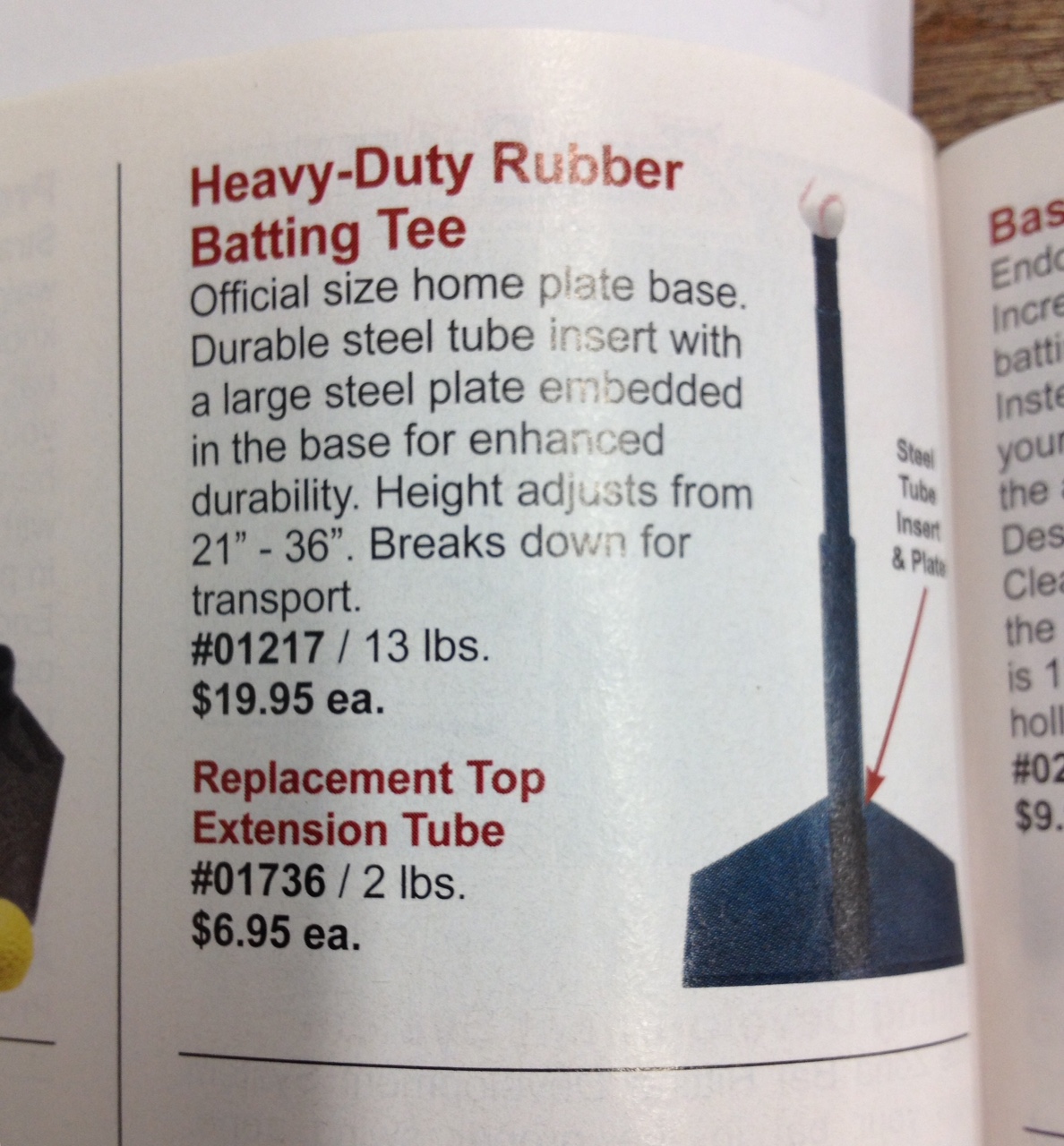
Here is a quality tee you can get for $20.

BattingTee

Thinking about spending $200-$500 on a bat? STOP!

First, and foremost, be willing to spend the $20 on a tee to teach the player to hit screaming line drives regardless of the bat they hold in their hands.

It is not the equipment that catches or hits a baseball; it is the skill of the hand that holds the equipment which accomplishes great things.

Buy a tee.

Learn how to use it.

Learn how to teach with it. See my earlier blog post, Hitting Position: The Hosmer Breakdown, for more information and keep an eye open to a upcoming post about tee drill progression. (And free open hitting sessions will start soon, also.)

Buy a tee. Hang a net to hit into or drill a hole in a ball and tether it to a 15-20′ piece of clothesline rope. Hit baseballs, plastic golf balls, tennis balls, or any kind of ball you can scrounge up.

Save yourself some money. Don’t be fooled into thinking a $400 baseball bat will miraculously make you or your kids a better hitter. At the end of the day, there is only one thing that makes a better hitter—WORK and REPETITION.

Have a great preparation to Baseball 2015!

Now, go buy a tee.

Leave a comment

Filed under Coaching, Rants, Training

Hitting Position: The Hosmer Breakdown

Hitting Position

Hitting position is a fundamental common to every good swing. The stances may vary, the styles may vary as much, or more, than the individual fingerprints of each and every batter, but HITTING POSITION IS A FUNDAMENTAL

A batter who gets to hitting position EVERY PITCH, no matter where their stance starts, makes for a consistent hitter. It’s important and it’s vital, and it’s simple. Hitting position consistency is key to being a consistent hitter. The best hitters in MLB get to hitting position every single pitch.

What is hitting position?

Hitting position starts the moment the stride (front) foot hits the ground. If you freeze frame this moment, this are the factors necessary for a proper hitting position:

  • Eyes level.
  • Front arm square or about at a 45° angle.
  • Stride foot landing of ball of foot and with a solid “stick” to stop forward slide of body. Outside of foot should be facing the pitcher.
  • Bottom hand stays in loaded position (at back shoulder level and over the back foot no more than 6 inches away from shoulder) with no lift of slide forward as weight shifts forward with stride.
  • Bat at 45° angle, do not wrap bat behind head.
  • An imaginary line drawn from the left foot to the neck to the right foot and back to the left foot should form a nice, isosceles triangle, indicating a balanced body.

isoc_tri_040_36972_lg

Load

In order to swing with a quick and powerful hitter’s swing, the body and bat needs to be loaded properly. Technically, it is a plyometric, pre-stretch of the muscle groups which allow for an explosive muscle fiber contraction and a quick, powerful swing. I tell hitter’s in my coaching sessions that it’s like shooting a rubber band at your sister. Do you take that big, thick, Sunday morning paper rubber band and only pull it back an inch before firing it in the direction of their beloved sister? Heck no! You pull that rubber band back as far as you can so you can fire it at that beloved sibling with explosive speed and power.

A baseball swing is just like this, and with a bonus. You can not only hit the ball hard every time at bat, but you can sleep well knowing that sister is not planning late-night revenge upon your person. Win-win situation.

The Load

  • Loose, relaxed grip on bat from a loose, relaxed body.
  • Bouncy – Athletes move on the balls of their feet, not flat-footed or with weight on the heels.
  • Hitter’s rhythm – rock side to side, when one heel comes off the ground the weight shifts to the other heel on the ground. Hitters should naturally rock with this rhythm almost unconsciously, even when just standing around. (It’s how we find each other in the crowd…look for the guys rocking back and forth in hitter’s rhythm).
  • Load – When weight rocks to back foot, the hands load to the back shoulder and lock into place. The rubber band has been pulled and now you are ready to stride and stick the perfect hitting position.

Offseason work

The great thing about these simple drills is the young hitter can perform them over and over and over again in front of a mirror from the comfort of the house all winter long without fear of breaking the new lamp or swinging a bat into the family’s new 52” HD television in the living room.

  • Bouncy Feet vs. Flat Feet – feel the difference between athletic feet (on ball of feet) vs. Coach Hays’s fat, old man feet (flat feet) as you hop 10 times with each style. Then do 10 side-to-side hops with each style.
  • Rock and Rhythm – a relaxed back and forth movement to train body the quiet weight shift of a hitter.
  • Rock, Rhythm and Load – check for proper load position, especially with lower hand to back shoulder.
  • Load, Stride, Freeze – check yourself for proper hitting position in the mirror.

 Hitting Position Breakdown of Eric Hosmer

 HosmerFrontViewHosmerSideView

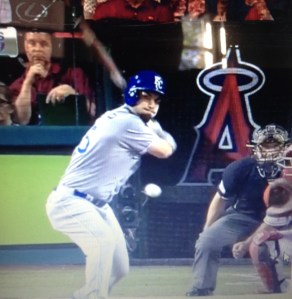
Here are a front and side freeze frame from the Vine video of Eric Hosmer’s home run in the 12th inning in the ALDS against the Angels. Hitting position. I froze the video when his stride foot hit the ground. Almost perfect. He naturally loads his bat a little further back than his shoulder, which runs a fine line between his compact swing when he’s hot and if he loads the bat even an inch or so further back. The further back a hitter loads, the straighter his arm becomes in the load beyond 45° the longer and slower his swing.

He is also shown here landing on the ball of his stride foot. As he swings and opens up the weight shifts back to his heel. His style, but one thing Hosmer does when he’s in a slump is land more on his heel than ball of his foot. When he does that his back shoulder dips, his arm straightens and his swing is long.

Right now, he’s money. Right now, he’s sticking his hitting position.

Hitting a baseball is not rocket science.

But, hitting with a fundamentally sound, consistent hitting position is the science of hitting rockets.

4 Comments

Filed under Reads, Training

Scoring Position

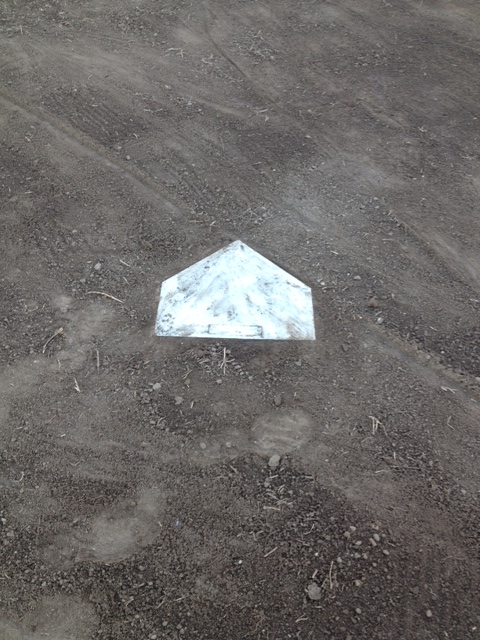
Most people think this base,

Home Plate
is the most important base in baseball. Home plate is where you score the runs, isn’t it? So, it has the be the most important base on the field, right?
Wrong.
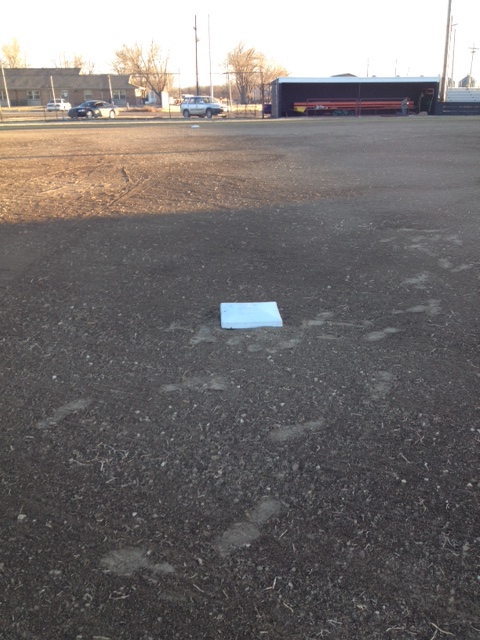
The most important base in baseball is this one,

Second BaseSecond base.
What?
Second base?
The one base, which doesn’t even rate high enough to get decorated base lines, is the most important?
Yes, it is.
Second base has another name in baseball–scoring position.

The key to successful defense is to keep runners out of scoring position; keeping the opponent from reaching second base. My philosophy has always been unless the outcome of the game is on the line, everyone on defense focuses on keeping the runners off second base. Give up a run, to save a bunch of runs later.

Pitchers need to throw strikes and avoid walks. They need to hold runners close on first base to make it difficult to steal second base. Catchers need to make it hard to steal second with quick, accurate throws and blocking balls in the dirt. All the other fielders need to communicate when the ball is in play and be intent on keeping runners out of scoring position.

The key to successful offense is to get runners into scoring position and beyond. Hustle ever batted ball to first base. Round the base hard with every single and look to take that extra base. Run the bases aggressive, but smart.

So, keep the most important base in your mind at all times when you play or coach this great game. The true battle in baseball is the battle for scoring position.

Take care of that lonely, unadorned base isolated in the middle of the infield; it’s critical for baseball success.

Good luck!

Play hard, play the right way, and have fun.

Leave a comment

Filed under Uncategorized

Throw & Catch

Throwing and catching a baseball. It is about the most fundamental baseball skill there is. It is also probably one of the most ignored. It is one of my baseball coaching, check that, it’s one of my biggest, most grating-on-my-last-nerve, plain coaching any sport, pet peeves.

Baseball_Images_Free_63

Baseball is generally broken down into three major parts: Pitching, Fielding, and Batting. In case you didn’t notice, throwing and catching a baseball comprise two of those three major parts.

Pitching is throwing to a catcher, right? And fielding on defense is catching baseballs and throwing baseballs. Like I said, skills that encompasses 66.66% of the game.  In my opinion, being able to throw and catch a baseball are the most vital skills you can possess as a team, or as an individual.

Poor catching and throwing often means poor baseball skill, which often translates to poor quality of team. As a player, take pride in how your throw and catch a baseball. As a coach, take pride in how each player of your team throws and catches a baseball.

Nothing puts a burr in my backside faster than watching a baseball team warm up before a game and seeing the ball hit the grass more than it hits gloves. Nothing is more embarrassing as a coach, than to watch your team running around the outfield chasing baseballs in some sort of demented circus routine. I’ve pulled teams off the field in pregame and pre-practice before due to playing chase, instead of catch.

Learn to throw and learn to catch. Find help if you need it.

For the coaches, hold the line and be firm and consistent from day one. Demand that your team throws and catches a baseball appropriate to their level. The simplest, single thing you can do to make your baseball team more successful is to improve throwing and catching a baseball.

Here is my basic coaching and teaching plan:

Daily Throwing
Focus on every throw and catch.
Consistency – Hit your partner in the torso with every throw.
Mechanics:

  • 4 seam grip
  • Throwing Arm -Elbow above shoulder, wrist outside of elbow,  hand with ball pointing back.
  • Lead Arm – Shoulder and elbow pointing at target.
  • Front Foot – Slightly open with outside stepping to target

Throwing (5-6 throws from each distance)

  • 30 feet apart
  • 60 feet apart
  • 90 feet apart
  • 120 feet apart (Long Toss = Builds arm strength)
  • Sprint to 30 feet for 5 quick throws

Catching

  • Keep it simple with a soft glove to the ball. Go and get it.
  • Where you glove goes, your off hand follows.

Take pride in your throwing and catching skills. Work on it every day. Focus and concentrate when you play catch. Talk, joke, or have all the fun you want, but remember the focus needs to stay on throwing and catching the ball.

Never forget this: If you can effectively throw and catch a baseball, you will be competitive in every game.

Leave a comment

Filed under Rants, Training

The Whole Alphabet

I was (am) a developmental coach. It’s what I do, teach the basics, build the fundamentals, and show kids how to compete. To me, the development of athletes is the core job of a sports coach.

In fact, for about any endeavor which requires training or supervision of people, the development of resources (people) is vital to a successful organization. Teachers develop kids; senior scientists take young scientists under their wing and show them what they know. Artists, writers, welders, mechanics all do the same, help develop the young or fledgling talent that comes knocking at the door.

Like I said, I am a developmental coach. The goal is to build a player from the ground up. Start with a fundamental foundation of physical movement skills and lay the bricks onto the foundation one at a time until a complete player begins to form.

Brick by brick we get better.

A coach can never emphasize enough the importance of the learning the playbook in football and baseball. We can work the fundamentals until we are blue in the face, but if the athlete fails to do the mental work necessary to burn the plays and responsibilities in their head, we are not going to be successful.

Below is one of my standard (and favorite) things to say to the young JV football or baseball players in order to get across the importance of studying and learning the plays to the point they become second nature.  

“The playbook is like the alphabet. If you learn all the letters, you can make any word you want. The world becomes wide open to you. If all you learn is A, B, and C, then the only word you can make is ‘CAB’.  You’ve severely limited yourself. And people, you can’t get very far in life when all you have in the arsenal is ‘CAB’.”

Leave a comment

Filed under Rants, Training, Writes

Perception is Reality (via Baseball Excellence)

From Baseball Excellence Tip of the Week newsletter 4/15/13

Perception is Reality– (A Tip for players) The way you act is how others perceive you. The way you conduct yourself on a baseball field in practice and games goes a long way as coaches determine how you will benefit the team. Your talent level “is what it is.” You can improve your skill level and you can have a positive approach. “It takes no talent to hustle.”

Respect the game.

Play with class.

Take Pride in the way you play the game.

Show an aptitude to learn. (Be Coachable)

Understand that failure is a part of baseball and learn to react in a mature fashion.

Always try to contribute something positive to the team (no matter how small)

Remember, you never know who is watching.

Baseball_Images_Free_63

Baseball Excellence is the best baseball, perhaps the best all-around coaching, resource I know. It has been integral to my development as a sports coach and defines who I am as a baseball coach. Most of the drills we did in our programs came from the Baseball Excellence Practice Planner. With the articles on their Instructions & Fundamentals web page, one can become a pretty damn solid baseball coach and a better baseball player. Simple, common sense, and effective methods.

Leave a comment

Filed under Reads, Training