Category Archives: Rants

Lipstick on a Pig

One of my coaches from way back in the day used to have this saying about trying to be too flashy with your game. “You can put lipstick on a pig, but it’s still a pig.”

Although I’ve never attempted to put any kind of makeup on swine, I understand the basic meaning of this old piece of wisdom. I’ve particularly become well-tuned to the spirit in this saying since I’ve become a sports coach.

To begin with, I think it’s all about being who you are as a coach, a player, or a program. Avoid trying to be something else. Be proud and be the best version of you that you can be. Strive to reflect this in everything you do.

I also think “Lipstick on a pig” means something that should be very important to a coach. The focus on the core goals of the program. As a coach, there is a fundamental need to focus on the important things—those things your program needs to succeed. Outside of this core mission, all else sits on the periphery.

Everything has to have a purpose and a meaning that’s all about the mission. A coach needs to keep everyone in the program riding the purpose and meaning tracks to the goal.

Unfortunately, in today’s environment, there are a host of distractions waiting to put lipstick on your pig. There are well-meaning distractions from parents and fans that pull the coaches and the players away from the goals. There are also the not-so-well-meant distractions by parents and fans which completely derail the program and make achieving any positive steps virtually impossible.

And as coaches, we often distract ourselves. We do things for the sake of doing things. We run schemes and shifts and motions without a hint of the purpose to gain information. We invest time and energy in shiny, new things, that provide little or no value to the goal.

Coaches, take a minute, step back from the program, and have an honest look at it.

  • What kind of distractions keep you from your core mission?  
  • What external distractions suck your time and energy and resources from where they need to be invested?
  • Are you spending more time running outside activities that detract from your program?
  • Is your training program laser-focused? Is every lift, run, jump, throw, sprint, and movement done with a sense of purpose in mind?
  • Is your philosophy consistent with your actions?

Coaches, in short, take a look at everything you do and identify where you’re wearing out that container of lipstick. Find out where you’re taking care of things not associated with your core goal. Everything needs to have a purpose. If it doesn’t, get rid of it. Those things are not worth the expenditure of effort and energy.

Never lose sight of the prize. Keep your focus, your performance, and your program on task. Don’t allow distractions to derail you from the track of success.

Putting lipstick on your pig may make for a fancy pig, but after everything is said and done, that pig is still a pig.

Develop a goal.

Develop a plan.

Do the work.

Leave a comment

Filed under Coaching, Rants, Training

THANK YOU!

Wow, people! You did it, again! Thanks to the generosity of many individuals and businesses, we were able to wire the down payment and start the manufacturing of this:

OUR NEW SCOREBOARD!

It should take about three weeks to manufacture and another week to be shipped. The Clay Center Public Utilities has offered to help with the installation.

After looking at many scoreboards of all shapes and sizes, we decided to stick with the basic 12′ x 8′ footprint of the current scoreboard. We went in this direction because it allows us to save money by using the existing support beams and posts and because this scoreboard was the best value of all the options we quoted.

I’m sure we will run into a few hurdles installing the scoreboard and learning to use the remote control systems but thanks to this incredible community, we have climbed the highest mountain. We’ve bought a brand new scoreboard.

When we started this project in September of 2013, we wanted to establish a spirit of for the community and by the community’ with Campbell Field and other facilities. Thanks to you, I think this is truly coming to fruition.

We invite you to visit Campbell Field to watch a game this spring or summer. Come out, watch some baseball, eat a hot dog, spit some sunflower seeds, and visit with other fans in a facility we hope is getting closer to being a baseball facility we can all be proud of.

THANK YOU!

I’d also like to give a special thanks to the Clay Center Community Improvement Foundation. As someone who has researched non-profit tools for baseball field fundraising since 2000 and always ended up overwhelmed at the legalities and paperwork, I can’t tell you how awesome it is to have this organization working on behalf of our community. The CCCIF allows a bunch of rockhead baseball guys to do rockhead baseball stuff while providing the infrastructure and the mechanics on the financial side of things. More importantly, they allow an organization like ours to raise money in a transparent and trustworthy manner.

Thank you, CCCIF Board of Directors!

Chairperson – Morree Floersch
Vice-Chairperson – Brad Dieckmann
Secretary – Karen Bryan
Treasurer – Robin Thurlow
Board Member – Jayson Hood
Board Member – Jill Mugler

Leave a comment

Filed under Coaching, Rants, Uncategorized, Writes

A Scoreboard

Our community is incredible, people! Thanks to the generous people and businesses who’ve donated their time, skill, materials, and dollars over the past four years, we’ve been able to complete some pretty awesome renovations at Campbell Field. It’s slowly transforming into a respectable high school baseball field.

Some of the upgrades have been documented in previous blog posts, The Beginning and Campbell Field Renovation Phase I, and over the next month or so, I hope to share the updates for Phase II, III, and IV. We are almost at the end of the trail for the renovations. It has been a long road since we started in 2013.

There have been highs and lows, successes and struggles, but even at the worst of times, it’s been fun for us. The thing we are most proud of is that the renovation costs involved minimum tax dollars, which we hope will allow more of the city recreation budget to be spent on actual recreation programs.

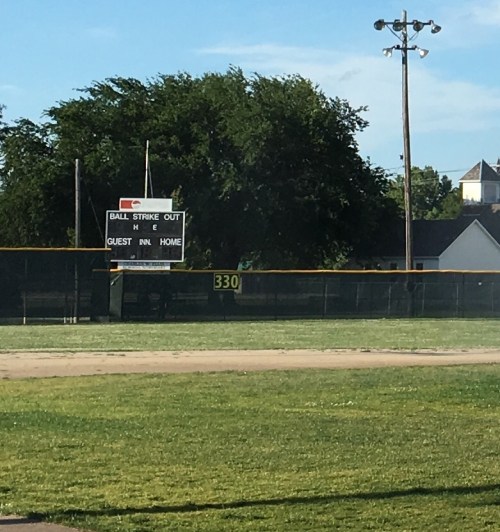
One final project we’d like to take a run at before we shift our focus from renovating Campbell Field to maintaining Campbell Field is to raise funds for a new scoreboard. If you’ve been out to watch a game at Campbell Field in the past few years, you’ve probably noticed one glaring dysfunctional part of the baseball landscape is our scoreboard.

Last April, an area high school coach complimented the upgrades to the field but asked if we are ever going to get a new scoreboard. I told him our scoreboard is special. It’s a home field advantage because we send coded messages through the system so only Clay Center baseball fans are able to decode the random symbols which are supposed to be real and actual numbers.

All joking aside. Our scoreboard is old. It’s been fixed over the years, but it’s at the end of the line. Many of the sockets do not work anymore. We’ve tried every year the past four years to repair it. We can’t find replacement sockets or light bulbs anymore. Even the second-hand parts we were fortunate to reclaim from an area town’s retired scoreboard did not solve the problem.

We are in the market to purchase a replacement. Nothing fancy, just a scoreboard similar to the one we’ve had the past 25 years that we hope will last at least 30 years or more. We’ve been shopping around and requesting quotes for a year or so. With freight and wireless controls, an updated LED model of what we have now will cost around $6000.00.

I know money is tight all over, but we would like to turn once again to the community and ask for your financial support. The Clay Center American Legion has joined us in this effort to raise money. The Legion would like to use the new scoreboard as a memorial to three men who had a tremendous impact on the sport of baseball in Clay Center, Oran Erickson, Walt Knitter, and Charles Ellis.

We have set up a fundraising account with the Clay Center Community Improvement Foundation. Your tax-deductible donations are greatly appreciated and, as always, we promise to spend every penny in the most efficient way possible with the continued goal to make and keep Campbell Field a source of community pride.

Below is the CC Community Improvement Foundation information if you are interested in making a donation to the scoreboard fund. Just designate your donation to go to the “Campbell Field Scoreboard Fund” and the nice folks at the Foundation will take care of the rest. We appreciate any help to purchase the scoreboard in memorial to these three great Clay Center individuals.

If you are unable to help financially at this time, don’t worry. Come out, instead, and watch a baseball game sometime or contact me to arrange a tour to see the improvements. Campbell Field and the Tommy Watt Batting Cages are something we are extremely proud of and we hope you will be too.

Thank you, Clay County!

(Note: If an organization or business is interested in becoming a Campbell Field sponsor, we have a Banner Donor level available. A 5-year donation commitment of $1000 ($200/year) will not only help the long-term support of Campbell Field but will get the logo & name of the donor organization or business displayed on a custom fence banner. If interested in becoming a Banner Donor, contact Larry Wallace, Jr. at 632-3345 or Rex Carlson at 632-2223 or email me at coachhays@gmail.com.)

Leave a comment

Filed under Coaching, Rants, Uncategorized, Writes

Baseball at Night

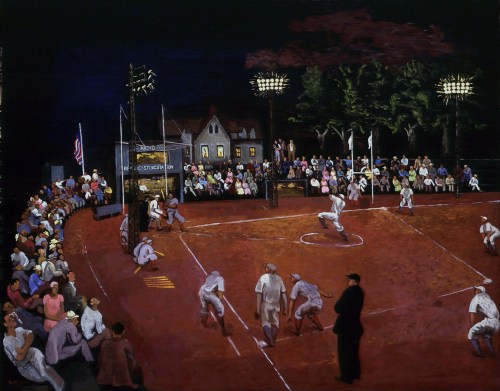
Baseball at Night by Morris Kantor, 1934 (Photo credit: American Art Museum on Visualhunt.com/)

I ran across this painting while researching for a potential book about one of my favorite baseball players of all-time, Josh Gibson. I was hypnotized by it. I need to find out more about the painting and its creator, Morris Kantor.  But, for now, I’m sharing it here as a reminder that, despite the half-foot of snow and single-digit temperatures outside, baseball season is just around the corner.

Baseball…

Dream on, people!


Leave a comment

Filed under Coaching, Rants, Reads, Uncategorized

Jump Higher?

Whether sports or academics or work or just being a good American citizen, we eventually come to obstacles standing in the way of our goals. When these challenges appear and make our path difficult, how do we react?

Do we lower the bar to make things “easy”?

Or do we work to jump higher?

Look around at America in 2018. We are adjusting bars lower and lower when we should be working in every facet to jump higher. We’ve forgotten something very important. The value of failure. Maybe even worse, we’ve developed a systemic fear of failure.

Why in this day of age is failure still considered such a negative result? Why is the connotation with failing the equivalent of bulldozing our garbage into a big hole in the ground at the landfill and covering it up?

Does failure = forgotten?

No!

Failure means you’re learning. Trying something hard and failing is a vital part of the development process. Everybody fails when you try to take your game to a higher level.

Everybody needs to lose every once in a while.

  • First, so that you learn that you don’t like failing.
  • Second, so you realize it takes work from you to overcome the hurdles in your life.  

The Fail Cycle. I am a believer in it.

Challenge. Attempt. Fail. Regroup.Train. Succeed. Repeat.

Look around, though. Take a good look at our expectations, especially those on our young people. Instead of rising to our challenges, aren’t we continually lowering the bar to decrease the possibility of failure? These kids are the ones we are going to need to fix the messes we are currently piling up. Their future will require great resolve and skill to successfully navigate the hurdles of the future. Our kids need us to buck up and help them develop this resolve and skill.

Why aren’t we teaching ourselves or our kids to jump higher?

Shouldn’t we be developing the mental, physical, and emotional muscle to reach the bar instead of lowering it? I’m not saying we need to go “Bear Bryant Junction Boys” off-the-deep-end, but we do need to quit lowering expectations. We need to figure out better ways to train them to jump higher.

I was watching Alabama’s championship game with Georgia when this thought first popped into my head. What about Nick Saban’s successful program results in consistently high performance? Maybe they cheat? Maybe they have some sort of unfair advantage? I don’t know.

But I do know one thing from studying highly and consistently successful teams. It’s about organizational expectations. The most successful organizations have developed a culture based on forcing their players (and coaches) to jump higher instead of lowering bars. The “next man up” better be ready to go or the guy behind him gets his chance. 

Keep your bars raised high and realistic. Establish a leveled-goal system. Work to attain a goal and then step up to the next level.

Jump higher!

Leave a comment

Filed under Coaching, Rants, Training

R.I.P. Weighted Bat

Well, the weighted bat thing goes way back. Way back to the ankle weights and wrist weights days. The shorty shorts, the knee-high white tube socks and wide terry cloth head and wristbands days of old. Just as these signs of poor fashion judgment have gone by the wayside, it’s time for the weighted bat as a way of supercharging your bat speed to go away also.

To be more specific, it’s the weighted bat swing training in the cage or in batting practice that needs to go away and not necessarily the heavy bats themselves. A baseball or softball swing is not an equivalent movement to say a squat or a deadlift. The baseball swing is a much more complicated movement, an intricate sequential firing of small and large muscle groups from the trunk to the torso that generates force across a linear and rotational plane. This force culminates at the point where the barrel of the bat makes contact with the baseball and, if all goes right, the ball flies off the bat.

Swinging a heavy bat in bp or in the cage only throws off the balance of muscle coordination a hitter works so hard to develop. Somewhat of a surprise is training with a lighter bat also does significantly increase bat speed. This is a surprise since research supports this methodology in speed training and other similar specific sports skill development. Swinging a bat is a just too much of an intricate physical process.

It takes thousands of correct reps and drills to develop a nice swing. Timing and speed are much more important factors to develop in your swing rather than pure strength. Strength training for a baseball athlete starts with the lower body where explosive strength and flexibility are the keys and moves to the core muscles of the torso. A strong core is essential for any athlete because it acts as a chain to transfer the force generated in the lower body to the upper body. Without a strong core, the energy generated in the load and step portion of the swing is left in the lower body and doesn’t transfer to the bat.

(On a side note, a throwing athlete like a quarterback, a pitcher, or any other baseball position player, should avoid straight military presses or any shoulder weight training which promotes an unbalanced muscle support of the joint. The shoulder joint necessary for overhead throwing motion is susceptible to injury if there is not a balanced training of the muscles surrounding this complex anatomical joint. This subject is a pet peeve of mine in the high school weight rooms where the specific needs of the throwing athlete are often ignored. But THAT is another rant for another day.)

All that negative stuff said, I still like the weighted bat in the on-deck circle for a couple of reasons.

  1. Use the weighted bat or “donut” ring it to get loose with a routine of several windmills front and back using both left and right hands, followed by a side to side rotational stretch.
  2. Mental edge. In the research that showed the use of weighted bats to gain bat speed was false, it was also shown the batter perceived his swing was faster. After swinging a heavy bat, the hitter “felt” his swing was faster. Handling a weighted bat in the on-deck circle can trick your brain into thinking your actual bat is as light as a feather and your swing is lightning fast. I don’t know about you, but give me a shot of confidence in the on-deck circle any day.

Hopefully, as with the Bug Squish, we can put the myth of using the weighted or heavy bat to develop bat speed out to pasture. But unlike the Bug Squish, I think there is value to using a weighted bat or a “donut” weight in the on-deck circle.

And to repeat…

One of the best pieces of coaching advice I can offer is this: Do not simply teach sports skills or coach simply because that is the way you were coached. Times change. Do the work. Research and field testing are constantly making improvements to the what we understand about sports science. Technology gives us access to this information like never before.  Ask questions, search the web, watch coaching video, or attend clinics. Do whatever it takes to give your kids the tools they need to succeed. When the players find success, they enjoy the sport. When they enjoy the sport, you can get more out of them.

Everybody wins!

Next R.I.P topic? Swing repetitions! How many swings at a time is effective? How many is too many? The answers may surprise you.

By Ernest Lawrence Thayer [Public domain], via Wikimedia Commons

Leave a comment

Filed under Coaching, Rants, Training

GM For A Day: Free Agent Edition

Here’s my rapid free agency analysis of what I’d do as the Kansas City Royals GM For A Day. They missed a great opportunity to trade these players for some future value because they wanted to squeeze a few more marketing dollars from the fan base. Not trading at least the Big Three (Hosmer, Cain, Moustakas) throws the rebuild from a potential 4-5 cycle to probably a 7-10 years cycle. It won’t be another 25-30 year cycle, I promise…

The Royals under Dayton Moore built the modern model of competing in the post-steroid (???) age. Draft well. Trade smart. Put together a core group. Let them lose 90-100 game and slowly get better over next two seasons. Make a run at a championship by bringing in free agent pieces to the big puzzle picture. Don’t get attached, use veterans to get draft picks, retool, and repeat.

The Royals management played the plan to a “T” until it came time to let guys walk out the door. The Gordon signing sent the plan reeling. An organization that should have had at least two World Series championships and four playoffs appearances fell short without even showing their face in the playoffs the past two seasons.

Free agency 2017-2018 needs to be focused on getting back to the plan. Cycle back to first base and start again.

What would old Coach Hays do?

(Royals Free Agent List as obtained from MLB.com)

Eric Hosmer

  • Let him walk and go cry in the closet for a week. I love the way the kid plays, but he’d bankrupt the organization. Signing him at even 75% of his market value will handcuff the organization for years. They could have possibly pulled this off if they’d shown some discipline and let Alex Gordon walk.

Alcides Escobar 

  • Keep. Escobar can be signed for a reasonable amount. He is a proven defender. His offense fits into a 7-9 in the order batter. He’s a known swimming in a swamp of unknowns. Also will allow the club to try and sell the potential of Raul Mondesi for a couple young arms.

Mike Moustakas 

  • Sayonara, Moose! What does Moose’s production mean in terms of “W”s? Not much. Let me put it in simpler terms. He had a club record 38 homers in 2017 and didn’t even crack 90 RBI’s (85). Solo HRs don’t win baseball games.

Lorenzo Cain

  • Walk. He is 31. At this age, he is already physically breaking down. Money spent on Cain might be money spent remodeling the training room.

Jason Vargas 

  • Walk. He doesn’t have the arm stamina anymore and may not get it back. He should have been dealt at the deadline before his arm withered and he floundered the second half.

Melky Cabrera 

  • Walk. He was in the way of younger outfielders. Bringing him in for the second half of 2017 hindered development of Bonifacio, Orlando, and Soler. The future was now for these young guys. Melky was a waste of time.

Peter Moylan 

  • Keep. He showed promise in the bullpen. Ned just wore him to shreds by mid-August.

Trevor Cahill 

  • Keep him & hope to hell he finds himself. (That’s the subject of my next Royals GM for a Day post…Hope to Hell These Guys Find Themselves.)

Mike Minor

  • Keep. At his price point, it would be a waste to not find out what he can do for the next 2-3 years.

So there’s my Royals GM for a Day, Free Agent Edition. What would you do? Please leave your ideas in the comments section. I’d like to read your ideas! And stay tuned for the next Royals GM for a Day, where we’ll look at the returning roster and dream.

Leave a comment

Filed under Rants, Uncategorized, Writes

R.I.P. Bug Squish

Squishing the bug.

Man, we used to teach this back in the day. Why? Lord knows!

Let’s squash the bug squish, once and for all. In 2017 terms and technology, it’s embarrassing to admit I fell under the spell of the bug squish back in the early 2000’s. The Load/Step/Swing philosophy of hitting I teach today used to be Load/Squish/Swing of yesterday. It’s crazy the way these things spread.

I don’t know how it happened, but the bug squish got out there in the world and people kept passing it along as the secret to good hitting. Looking back through the lens of speculation, it was probably a remnant of early video analysis or maybe just observation.

When you watch a good swing in real time, it looks like the back foot “squishes the bug”. It can be misinterpreted as this back foot, combined with the old school maxim of “pushing” off the back foot, made the outward twist of the batter’s heel look like the initiator of a good swing. It doesn’t though. The back foot twists after the swing starts and the movement of the force from the front foot strike to the hip rotation result in the back foot movement.

  • The Bug Squish screws up a proper and smooth weight transfer from the load to the step. It leaves too much weight on the back foot and results in a loss of force. And lost force = lost bat speed = not driving the ball on a line = not getting on base = making a lot of outs = not getting on base = not scoring runs = not winning games = NO FUN.
  • The Bug Squish screws up your balance. A good swing is built on the foundation of balance. Bad balance and you cannot build an effective or consistent swing.
  • The Bug Squish screws with a hitter’s mind. The hitter becomes so focused on what that back foot is doing, they don’t put all their focus on the ball.

No matter what the stance or the style, the best swings in the game all share the common factor of a good and consistent hitting position. Hitting position is the key. A simple lower body movement to get to hitting position only becomes a complex movement with the introduction of gimmick BS like the bug squish.

It’s 2017. It’s time to bury the bug squish for good. It’s time to look past these old sports coaching myths. It’s time to simplify hitting a baseball.

One of the best pieces of coaching advice I can offer is this: Do not simply teach sports skills or coach simply because that is the way you were coached. Times change. Do the work. Research and field testing and forward-thinking coaches are constantly making improvements to the what we understand about sports science. Technology gives us access to this information like never before.  

Ask questions, search the web, watch coaching video, or attend clinics. Do whatever it takes to give your kids the tools they need to succeed.

When the players find success, they enjoy the sport. When they enjoy the sport, you can get more out of them.

Everybody wins! Right, Crime Dog?

1 Comment

Filed under Coaching, Rants, Training

Repetition

You want to be good at something?

Okay, okay. I know. That answer is easy. Everybody wants to be good at something.

But what does it take to get good at something?

You have to do whatever that something is over and over and over and over and over and over. Get the picture?

If you want to be good at something, you have to practice that something well. You have to repeat it.

Repetition is the key. Repetition with purpose.

If I want to be a good hitter, I need to repeat my swing over and over again. I need to repeat my over and over again while attempting to get a little closer to a perfect swing with each subsequent repeat.

If I want to be a good writer, I have to write. Over and over and over again. I need to work at crafting the words better with each idea and each sentence. Repetition.

Very few, if any, kids walk into first grade, kick up their feet, and tell the teacher they’re ready to read War and Peace. The first graders have to learn the sounds the letters make, learn the combinations and then the meanings. Thousands of repetitions are required before your average first grader is going to where the wild things are or even seeing Spot run. Thousands of repetitions, hundreds of mistakes and failures. Being good at something is all about the Fail Cycle.

  1. Try
  2. Fail
  3. Regroup
  4. Learn
  5. Try again
  6. Succeed
  7. Level up
  8. Back to #1

Practice with a purpose. Repeat with the purpose in mind. Get better.

  • Hit the ball harder.
  • Write better stories.
  • Teach kids to read.
  • Construct a house.
  • Repair a car.
  • Operate a farm and/or a ranch.
  • Design a bridge.

Anything worth doing is worth doing right. Anything worth doing is worth doing the best you can.

Over and over and over and over and over again…

Why all this nonsense on repetition with purpose?

Because I think we are in a place where we want the “Easy Button”. If it ain’t easy, I ain’t doing it. Failure means “quit trying”. Failure means packing up the tent and crawling home. We want to be good, we want to pound our chest about how awesome we want to be, but we forget the “anything worth doing” bit.

We forget the satisfaction is in the journey and the trials and the tribulations. We forget that if we do the work and do the practice and do the repetition, good things usually happen. The “Oh yeah, that thing is really hard, but I just kicked its ass” feeling is a feeling like no other.

Speaking of repetition. This is post #399 on The Coach Hays Blog. Who would have ever guessed when I started this thing back in 2009 as an energy outlet after my football coaching career went belly up it would still be in existence?

I guess the better question is, how can one guy be so damn stupid?

Thanks for hanging around and putting up with my rants and raves and idiocy.

Who knows what the next 100 posts will bring?

More repetition on the theme of STUPIDITY without a doubt!


1 Comment

Filed under Rants, Reads, Writes

The Best Years?

There’s a nugget of life advice often given to high school kids, particularly high school athletes. A nugget that is so off-the-rails I cannot believe it has survived

“These are the best years of your life.”

Best years? Lord, I hope not! The best years of your life in high school? That seems kind of depressing forecast on the power and potential of each young athlete and student.

The BEST years?

No, but they are special years. They are years in which the high school students are afforded unique life opportunities. They are special because the future is a blank and open canvas.

Teenagers, listen up! You may feel a giant load of pressure right now to define your future. The system will tell you that you should have the specifics of life cemented firmly in place by graduation day. Teenagers, when that day arrives and this pressure mounts, fling off this weighted jacket of the system’s expectations.

The canvas of your future should be painted with your passions and desires and likes and dislikes. 

It’s okay not to know exactly what you want to do with your life when you are 18. It’s okay to say no to the dreams others have for you that aren’t fit for you. It’s okay to try something and fail and then get better for another try.

So why do we so often call these high school years the best? They aren’t. Or they shouldn’t be if you pursue your dreams.

Why do we, as adults, anchor kids down with low expectations? Teenagers grow up. Teenagers have great value even though they often bury or masks their potential. And sometimes, kids just need to get away and find another environment in which to blossom.

There’s an old coach’s saying. “The best thing about a freshman is that he becomes a sophomore.”

I believe in that saying and an expanded version which reads,

“The best thing about teenagers is that they become adults.”

As a coach, as a teacher, or even as a parent, remember those teenagers who are driving you absolutely bat-poop crazy today, have the potential to be awesome and productive citizens in the near or far future. They need dreams, resources, and some adults to believe in them.

Believe in your kids.

See the good in them.

Recognize their potential.

Help them down the path to fulfill their passions.

Make them work to achieve their dreams.

Be there to help them rebound when they fail.  Give them the space to back up, reassess, grow, and attack time after time until the dream is a reality.

Develop in them a strong gluteus maximus rubberi, so they know how to bounce up when life knocks them on their ass.

And please people, stop it with the “best years of your life” advice to teenagers. Teach them to believe in the potential of tomorrow. Teach them to work and to fail and to bounce back.

The high school years are special years. Enjoy every minute and every experience. But graduating high school is not the endgame. Life is the endgame. And, if my math is correct, most of us hope to have much more life to experience after high school.

To each and every teenager I ever had the opportunity to coach, I am proud of the adults you have become or are becoming. Your best years were definitely beyond any of those years you spent on a sports field with me.

Keep the faith in yourself!

Leave a comment

Filed under Rants, Uncategorized, Writes