Tag Archives: Coaching

#ThatSportsParent

One of the scourges of modern youth sports is out-of-line parents. The headlines are full of incidents involving overzealous parents. Odds are, each of us can pinpoint an incident of ugly parent behavior at a sports event no matter how small a town we live in. It’s threatening the very existence of youth sports and, more importantly, taking the FUN out of the game.

But when is it okay to get involved as a parent?

“So what happens when you’re the parent that yells for your own son (good but not the star) to sit so that a few of the others on the team can get some playing time because you’re up by 10 to a way lesser team? ”

Somebody I respect greatly asked me the above question a few weeks ago. It’s a tough question to answer, but I’ll give it a try. I’ll try to answer from a coach’s perspective and try to wall off my parental perspective because Lord knows, I’ve screwed up many times on that side of this issue. I’ve been there. I’ve felt the parental frustration seep its way into my competitive fire in less than positive ways.

So, here’s my personal philosophy on sports parenting and complaints.

First and foremost, a parent should be their kid’s biggest fan, not be their sports agent. There are truly legitimate situations in which a parent should intervene on behalf of their sports child. Physical, mental, or emotional abuse from either other players or from coaches should be reported immediately. In these situations, the parent needs to be the bulldog, the protector, and jump in and refuse to back down until a resolution is achieved.

But sports parents, listen up…Depth chart and playing time and play calling probably do not fall into this category of necessary parental intervention.

I’ve always felt there are three things every parent needs to do before they get involved. They are not easy to do. A parent needs patience and the ability to wall off emotion in this context.

  1. Observe the situation from an honest viewpoint.
  2. Be honest. This can be soooo hard, especially if you have those visions of your kid being the best thing since sliced bread. Step back and take an honest look at where your kid’s talent falls in respect to the other kids.
  3. Allow your kid to handle the simple situations. Have them find out from the coach or other players where they sit and develop a plan to get better.

My playing time thoughts depend on the level of play. If it’s a varsity high school level of competition, I believe in playing as few, or as many, players as necessary for the situation. We want to be highly competitive at the varsity level. We also want to balance player/program development, situational skills we may need to groom for later use, and get game reps with new plays or skills.

The developmental level of competition, middle school, freshman, junior varsity is where I like to play everyone as equally as possible during a game. Sure, the goal is still to win the contest, but we need EVERYONE in the program learning how to do their job in order to achieve success as a team. The game situation is where we can identify individual or team areas for improvement while gaining experience. The future, both the near future or the far future, carries a higher priority at the developmental level than winning or losing. (The developmental level is where many parents allow the basic purpose to slip away and the emotions to pressurize.)

Finally, there is the private or club sports environment. This area has grown by leaps and bounds over the past decade. My only advice right now for parents in these situations is as follows:

If you, as a parent, are unhappy with a club situation, whether playing time, depth chart, game management or practice management, then I suggest talking with your kid about the situation. If it bothers your kid and/or the other kids on the team, then schedule a meeting with the coach.

Schedule this meeting at a neutral emotion time (NOT before, after, or during a game, a practice, or in a public setting.). Meet with the goal being to solve the problem, not create new problems.

If you are unhappy with the outcomes of this meeting, I suggest moving to a new situation for the next season.

If you are unhappy seek a viable alternative or take advantage of alternative solutions that are presented to you. Don’t spread your misery. Sports are too much fun to be blanketed in this negativity.

Sports can teach kids a lot about life. Allow them to learn. Allow them to develop. Allow them to understand being part of the whole is better than trying to be the whole part.

Give them the opportunity.

most-annoying-sports-parents.jpg

Leave a comment

Filed under Rants

Your Purpose 4Q

Execution of purpose.

We’ve all heard the saying, “Practice makes perfect.”. Our parents, teachers, coaches, etc. have been telling us this little nugget of wisdom for years upon years, right? Well…it’s about as wrong as me watching the Olympic track & field competition and claiming I’m exercising.

Practice makes perfect ONLY if your practice goal is to be perfect. This means every repetition you perform—and skill development is ALL about repetition—must be done with a drive to improve. A drive to get just a little better each and every time.

We all go through the motions at times in our lives. It’s another slice of human nature. It’s just as easy to coast through practice as both a player and as a coach. This is particularly true as we approach the last third of a sports season and the routine gets…well, routine. As I said in the previous post, time is our biggest enemy. I think we can agree on that, don’t you?

THEN WHY DO WE COACHES WASTE SO MUCH TIME???!!!!

Sorry for shouting, but that wasting practice time thing is a pet peeve of mine. As a player, I hated the standing around doing nothing when there was a whole lot of talk happening and very little action. It drove me nuts back then and still drives me nuts as a 52-year-old.

Have your purpose. Have your plan. But most of all, have the drive and the ability to lead others toward the goal. A coach has to keep a practice session hopping. The average adult attention span (8 seconds) has now dipped below the average attention span of a goldfish (9 seconds). I could infer then that the hormone-driven teenage boy’s attention span would stand to pale in comparison to the goldfish. So if you are going to successfully deal with young athletes, you’d better plan on keeping things short and snappy.

Every season, every week, every day, every minute, every second need someone driving the bus in the right direction and at the right speed. THAT is another one of those unique characteristics of good coaches.

I am a firm believer in coaching fundamentals and drilling fundamentals. A technically sound player is a player you can depend on and build a team upon. There’s only one way to develop a technically sound player and that’s by working toward the goal of perfection with practice and repetition

In fact, you can even sneak this work in where the players don’t even realize they are working. During football practice, we used to do a 15-minute session at the start of practice with the kickers, long snappers, holders, and returners working on their skills. A good portion of the QBs, running backs, and receivers would be a part of this but very few linemen which left a big (both in sheer numbers and sheer size) part of the team watching.

Nobody likes to stand around and watch kickers kick, so we started this game where the linemen did a one-on-one pass drill. Coach Lane and I would be the quarterbacks, each with a line of lineman with us. The first guy in line would jump out and play defense and the second guy would be the receiver and run a pass route. The fifteen minutes would fly by. The Bubbas would really get into the competition, trying to score a reception on the offensive side or getting an interception or a pass breakup on the defensive end.

It was fun! The linemen would get the rare chance to touch the football, they would get a chance to talk trash and prove their skills in front of everyone. I also had fun slinging footballs in my best Kenny Stabler imitation.

But while all this was going on, nobody ever realized they were actually working. They worked on their footwork, they worked on their hand-fighting skills, and they learned how to establish leverage. I think anyone would agree those are all skills important to being a lineman. Also, they probably ran the equivalent of around a dozen or so sprints without complaint or without notice. In contrast, when we lined them up after practice to run a dozen sprints for conditioning, you should have heard the groaning and whining.

Bottom line: Execute your purpose and DON’T WASTE TIME.

In particular, don’t waste practice time. Maximize your purpose in your practice. Every single thing you do should be done for the purpose of getting better. There is no standing still in life or in sports. You are either getting better or going backward.

By the way, it’s too bad no video record exists of the quarterbacking skills of Coach Lane and myself. It was glorious. Not shabby for a couple offensive line coaches. Don’t laugh, I still have the sore arm to prove it…

OLYMPUS DIGITAL CAMERA

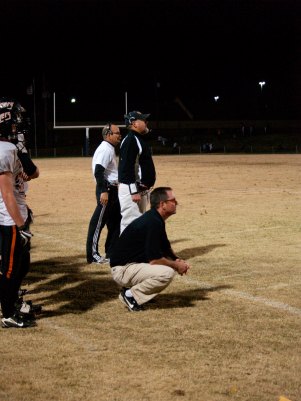
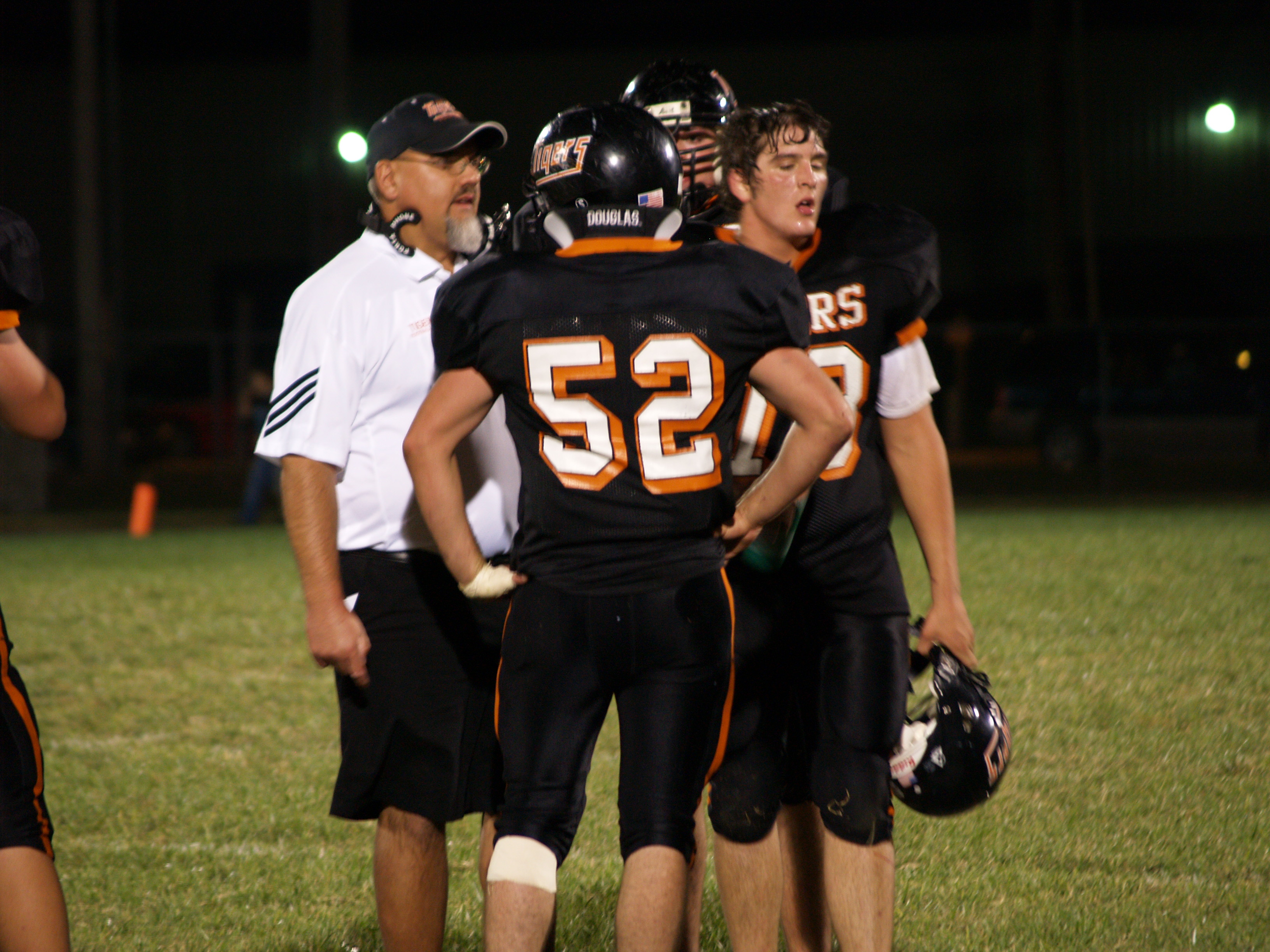
There wasn’t a whole lot of executed purpose this night, but the picture with the Lane Brothers is one of my favorites and one of the few “action” shots I have.

Final Note: The “Your Purpose?” blog post began as a rant that grew and grew until it was beyond the scope of one post. It became a four post rant. Yowzers! But I’ve seen this problem of lack of purpose derail many teams and programs. Teams that I played on, teams I’ve coached, teams I’ve observed and teams I’ve been a fan of. It bugs the hell out of me, both in my own failures and observed failures. It seems so simple. It seems as simple as wearing pants before going out of the house. You wear pants when you leave the house, don’t you? Then why go “pantless” when you approach coaching?

Leave a comment

Filed under Coaching, Rants, Training

Your Purpose 3Q

Time.

We all fight it. We all struggle with it. It’s always moving and there never seems to be enough of it.

Double this sentiment for a sports coach. Time is our biggest enemy. Wasted time is a coach’s biggest regret. That is why we have to build a purpose of time into our greater purpose.

Okay, let’s say we want to win the football game against our rival next Friday night. We need to purpose our time properly. We need to develop a strategy that helps us achieve the vision. We watch scout film, both on our rivals past few games to determine how they approach a game and, just as important, our recent games to evaluate our mistakes. We need to organize and execute the practice preparation to get ready for the contest.  As you can see, every second matters.

Success is no accident or random occurrence.

Time is valuable. It is valuable to everyone. That is something I think we, as coaches, often fail miserably at. Kids have more legitimate time constraints now more than at any other time I can ever remember. Family responsibilities, church obligations, school obligations, extracurricular activities, work, hobbies, multiple sports commitments that demand time, especially in the summer.

As an effective leader working under today’s time constraints, you need to make the most of the time that you ask your players to commit. If you are going to ask them to come for summer conditioning every day at 6:30 AM, you damn well better send them home at 7:45-8:00 AM exhausted and drained so they feel like getting up a 6:30 AM was not a waste of their time. That responsibility is part of the unwritten trust contract I always felt was so important to establish between coach and player. We, as coaches, should be able to look the players in the eye after every practice or workout and say, “Today, I did not waste your time.”

Be able to fulfill that promise with a solid purpose of time day after day after day and you will have a team who will follow you to the ends of the earth. A team who will jump into the fire with you and compete with every fiber of their being. A team who will believe in your purpose and wrap themselves heart and soul with it. A team with complete trust in you as a coach; a trust that weaves its way through every member of the team.

  • THAT is the point of critical mass.
  • THAT is when the fun starts.
  • THAT is the magic of sports.

And it all starts with TIME.

Wooden_hourglass_3

Leave a comment

Filed under Coaching, Rants, Training

Your Purpose 2Q

“Great dreams aren’t just visions, they are visions coupled to strategies for making them real.” – Astro Teller, X (formerly Google X)

Early in my football coaching career, probably my second or third year, I did one of the most asinine things I ever did as a coach. It was the first week of summer conditioning. A good part of the CCCHS summer conditioning program was my baby. It was a huge responsibility. It was a responsibility I did not take lightly. It was my primary purpose.

I did the work. All year. Researched, read papers, visited K-State Strength Coach Rod Cole, watched videos, etc. ad nauseum to 99.99% of the population. I tried to put together the best program for our kids with the equipment we had or what could be scrounged up or made by the wizard-skills of Coach Lane. It was, a vision coupled with a strategy.

  • Our purpose was to physically hit the opponent like a cannon shot every, single play.
  • Our strategy was to develop the explosive power necessary to generate the force to hit the opponent hard every, single play. In a nutshell, F = ma.

So, the plan was set. We had a good start to the first week. The kids had listened well and picked up on the plan. Sure, there was whining and moaning and even some groaning, but if you’re a coach and you’re not getting some of that appropriately directed complaining, you may reevaluate how you are challenging your kids. I was feeling good. I was riding high.

We show up for the Thursday workout. 6:30 AM. We go through warm-ups. The kids come into the weight room, split off in their Bullets, Bricks, and Bubbas groups, and get to work. Next came the asinine, Coach Hays incident. It started with an innocent tap on my shoulder. I turn and there stands an innocent, young freshman holding a half-inch stack of dot-matrix printer paper and looking down at the ground to avoid all eye contact.

“Yes?” I ask the young man.

He pushes the stack of papers toward me and mutters, “My mom told me I need to do this workout.”

“Oh, really.”

“Yeah, she found it on the internet.”

I nod and take the papers. With the young man still standing there, I take one step forward and ceremoniously drop the internet-found road to athletic glory into the trash receptacle. I then address the bug-eyed, jaw dropped to his navel, freshman.

“Tell your mother where your workout ended up”

He had that distinct look of someone who was about to pee their pants.

“Also, tell her we know what we’re doing. Now go get to work.”

He released a slow sigh of relief, smiled, and joined his workout group. Not a word was heard on that issue again.

Take-home lesson:

  • Have a purpose that is backed up by a solid plan.
  • TRUST the plan.
  • SELL the plan to your people.

Also, don’t be a jackass in the process…unless it’s totally necessary.

Great dreams need a vision.

Plate

Note: That young freshman turned out a pretty damn good athlete in the long run—even without the collective intellect of internet weightlifting workouts. Excellent football player, state-caliber wrestler, all-around good (and ornery) guy, and very successful adult family man/businessman.

1 Comment

Filed under Coaching, Rants, Training

Your Purpose?

“Dreams aren’t just visions, they’re visions coupled to strategies for making them real.” -Astro Teller

Purpose sounds like something so, so simple. It seems like common sense to have a defined purpose when one takes on an endeavor. Especially in a sports endeavor, you would think approaching that sport with a purpose and a systematic plan would come natural, right? It seems purpose should be one of the necessities of sports coaching, don’t you think?

Truth is, it’s not.

Wanting to win is not a purpose. Everybody wants to win. It’s human nature to want to succeed; it’s written in our DNA. But what sets coaches and programs apart from one another often starts with purpose. Effort and hard work are essential but without a purpose effort and work are wasted.

I used to see this lack of purpose, or more accurately a lack of defined purpose, quite often in the coaching world. There are two types of purposeful coaches. The first are the ones who just copy or borrow a purpose. You see this type a lot at coaching clinics. They hear a talk or see a workout or scheme program and take it lock, stock, and barrel back to their kids and try to make their kids fit into it.

The other type of purposeful coach—the ones I think are generally more successful in their programs—take the same information as the first type of coach but they pick, choose, and mold those ideas to fit their athletes. They know their purpose and know how to mesh information to support their purpose.

In high school sports, a coach must lead with a purpose. Every day and with everything you ask kids to do must be done for a reason. You can’t throw a blanket idea out there expecting the kids to see the purpose and commit to it. That is not what a leader does.

A leader leads.

A leader has a defined purpose.

A defined purpose that is custom fit for his or her athletes.

A purpose that gives the athletes the best chance at success. A purpose they also can envision. A purpose they willingly dedicate themselves to attain.

Everybody wants to win. They just need guidance and need to be shown the way.

The answer is not simply in a book. The answer is not simply in a purchased training program. The answer is not what Coach X does at X College.

The answer is defining a purpose that your people can buy into. A purpose that does not waste their time and not wasting kids’ time is VERY IMPORTANT in today’s culture. A coach is competing with all kinds of pretty damn fun and cool alternatives to working your ass off for three hours a day every day, you better make your time with them worth THEIR time.

Whatever the endeavor, if you’re not happy with the results you are getting, try redefining your PURPOSE. You and your people may find you like the results.

Rings

Leave a comment

Filed under Coaching, Rants, Training

Trained Eye

“At Level I (certification), they told us we would be practicing and refining the basics for the rest of our career, but the truth of it is that I and many others had approached it looking for the step-by-step instructions that made us worthy of the title “Coach.” We came for our checklists and expected to leave with a certificate. But it doesn’t work like that. Because no amount of technical know-how can substitute for a seasoned coach’s eye. That’s what I was missing at my Level II: I was aiming too low.”      – Greg Woods,  SFG II-Certified Fitness & Training Coach

It is the eye that makes the difference. The eye which is developed through hours and hours upon hours of watching and learning. The Trained Eye as we often call it. The Coach’s Eye. Something that the most effective coaches have.

Something that the most effective coaches have.

Something ineffective coaches lack.

It is the ability to watch and see the correct movement. The ability to see the incorrect movement, diagnose the problem and take the proper corrective action. The ability to recognize and analyze the patterns of a skill or game is vital to success. It is gestalt psychology put into action that often separates skill level. Mastering the necessary patterns should be the goal of any training or coaching endeavor. This is what the Trained Eye is all about.

Hitting a baseball, for example, is a skill I like to think I have a pretty decent Coach’s Eye for (see Hitting Position: The Hosmer Breakdown post). This particular eye for hitting a baseball has been a 50-year work-in-progress. I’ve been a hitter since I was old enough to lift my Carl Yastrzemski-signed 28” Louisville Slugger wood bat above my shoulder. I had great coaches, brothers, and neighborhood baseball gang to lay the foundation of growing up a hitter.

I studied hitting by watching live games and batting practices and games on the TV and by hitting. Later as a coach, I became a disciple of front hand hitting and learned from observation, videos, books, and the old standby…trial and error. To make a long story short, my eye for coaching hitters took hours and hours upon hours. (And I’m still learning!)

Football offensive and defensive line coaching was no different. Neither was strength and conditioning coaching. The Coach’s Eye was necessary to teach proper footwork, body positioning, hand placement, and leverage. Knowing what these skills look like, knowing how to teach them effectively, and knowing how to correct them, are vital to success.

I often get strange looks while coaching hitting sessions or watching games when I make a comment about how a hitter is off-balance or a defensive end loses leverage and gives up a big play. What earns strange looks from these otherwise normal human beings? In these situations, I can see the pattern when others can’t. The spatial relationships of a swing at a low, outside fastball or weaknesses in a defensive front stand out when I watch them.

As the 2016 Olympics draw near, pay attention to the judging and coaching with the world-class athletes competing in Rio. Challenge yourself to try and see the patterns. To my untrained eye, all the gymnastics routines look pretty much the same—unless somebody falls. Finding the consistent patterns in these sport movements is tough to the casual observer. The difference between a gold medal and simply being there for the post-event party in the athlete’s village is often a whisker-thin-line only noticeable by the trained eye of a coach or a judge.

Not surprisingly, the Trained Eye goes beyond the realm of sport.

In science, trained eyes make great discoveries.

In art, trained eyes produce beautiful works.

In writing, stories get “easier” to create at a higher level of quality as the development of the Writer’s Eye improves.

Just about any skill or ability to teach any skill improves with hours and hours upon hours of development of the Eye.

Find your passion and get started on your own Trained Eye.

Iris_close-up


Leave a comment

Filed under Training, Uncategorized

It’s Only JV

I left the house with purpose of mind. As soon as the local high school baseball practice was over, I’d jump on the field, rake the pitcher’s mound, rake the batter’s box, drag the field for tomorrow’s home JV baseball game, and get home in time to eat dinner with my wife. Thirty minutes…tops. Life has been a little crazy lately so I thought nobody would really mind if we just did the basic field prep work and went home. I told myself it was only a JV game. Get the field playable and forget all the bells and whistles of a normal varsity home game.

We finished the mound. We finished the batter’s box. I ran the finish drag around with the mower while RC hand-watered the pitcher’s mound and batter’s box. Well, it was only a JV game. 90-minutes later, I am raking the limestone track around the backstop with the new sprinkler laying down a fine spray of water on the dry-as-a-bone dirt and I pause to look at my watch. 90-minutes. Yeah, I missed dinner with my poor wife.

I continued to rake until everything was in its pre-game place.

I know it’s only JV game, but there is no “only”.

Every game matters. Every game is important.

A game deserves the very best of what we can give.

Every play, every pitch, every possession.

Life is like a JV game. It’s not often in the spotlight. It is not all glory. It is work. It is getting better every minute of every day. It is giving your best even though the crowd is small and nobody seems to really be paying attention.

This environment is where you get better. Get better at your game, your art, your career, your very human-ness.

Put your time in. Do your very best. And then wake up and do your very best tomorrow.

Hard work is the magic.

IMG_2900

Leave a comment

Filed under Uncategorized

The Work Necessary

The Kansas City Royals are 2015 American League Champions!

The Boys in Blue are in the World Series against the New York Mets!

But a weird thing happened the morning after they won the ALCS over Toronto. Instead of waking up 100% joyful and ready to roll for the Series, I woke up thinking about two plays from ALCS Game 6 and how these two plays spotlight the value of coaches doing the work necessary for their players.

  1. When Alex Rios stole second base against David Price, a left-handed pitcher who allows unbelievably few stolen bases when he is on the mound.
  2. When Lorenzo Cain scored the game-winning run from first base on Eric Hosmer’s double down the right field line.

Both plays, at face value, look totally like big plays made through the exceptional speed and athleticism of those two athletes. But if you look closer, listen to the announcer comments, and the postgame interviews of players and coaches, you begin to see a whole different story.

True, Alex Rios and Lorenzo Cain are two incredibly gifted athletes but that is not what gave them the advantage and confidence to execute those clutch plays on one of the biggest stages of their sport.

What gave both players the edge was the hard work and analysis of the coaches and advanced scouting department.

Yeah. Coaching matters, scouting matters, preparation matters. Hard work IS the magic. Although both plays look to be just a couple of plays of guys running, the amount of time and effort—film study, the scouting report from the scouts following the Blue Jays for the past few months, transfer of that information to the player—are staggering.

Case One – Rios steals second base on a jump he takes off of the first movement home by David Price. Price is difficult to steal on. He’s left handed and although he doesn’t have a great move, he has a quick slide-step delivery which makes it hard for the runner to get an aggressive lead or jump. Scouting appears to have picked up on a tendency for him to sometimes forget about the runner and not give him a “look” when he’s going to pitch the ball to his catcher. For several pitches, he peeks to Rios before delivery to home. On this particular pitch, he doesn’t peek or look to first base and goes straight home, Rios runs on Price’s first movement and is safe with a stolen base–the VERY FIRST stolen base allowed by David Price ALL YEAR. Rios did not end up scoring, but it was a blow to the confidence level of the Blue Jays and added to the pile of things they had to think about.

Scouting, picking up on tendencies, AND being able to relay those details to the player = Makes the game looks easy.

http://m.mlb.com/video/topic/28898650/v525581583

Case Two – Royals third base coach Mike Jirshele and the scouts studied Toronto’s exceptional right fielder, Jose Bautista. They noticed he often fields a ball down the right field line and spins to throw the ball by turning his back toward the infield instead of opening up frontside where he would be able to see the infield all the time. They also noticed he almost always wheels to the blindside and throws the relay to the shortstop positioned around second base.

Coach Jirshele planned on taking advantage of this if, and when, the situation arose. Well, it arose. In fact not only were the players coached this during practices and meetings, but they were given a refresher before game six AND Coach Jirshelle revisited this with Cain and Hosmer BEFORE the inning even started since they were due to bat.

http://m.mlb.com/video/topic/135309324/v525692683

Preparation works.

As a coach, when you watch hours and hours of film or live action, you begin to see patterns. When you rewind and watch a play over and over a dozen times or more, the structure patterns emerge. These patterns become tendencies when put together and analyzed.

  • Tendencies allow a coach to focus preparation.
  • Tendencies allow a coach to focus teaching.
  • Tendencies allow a coach to give his players an edge.

The word “Coach” must be used as a verb, rather than just as a noun. 

As a coach, do the work necessary to put your team in a position to succeed.

Hard work is the magic.

OLYMPUS DIGITAL CAMERA


Leave a comment

Filed under Coaching, Training

How In The World…?

Another DAVID AND GOLIATH post on one of my favorite football coaching memories.

I learned a valuable lesson about succeeding as the underdog early in my football coaching career. I learned this from our offensive coordinator at the time, Coach Dail Smith. He didn’t sit me down and explain this lesson. It didn’t pop into my head like a light bulb of understanding. I learned this valuable lesson from a short pre-game talk at the 50-yard line of Otto Unruh Stadium with the head coach of our most bitter rival, the Marysville Bulldogs.

As the lowest coach on our program’s coaching totem pole, it was my job to remember to get the VHS trade scout tapes from the equipment box and return them to the opposing coach before the game. (Yes, back in the dark ages, the upcoming opposing coaches would meet on Saturday morning and trade game tapes from the night before and the week before. I imagine the HUDL online system is golden compared to VHS trade tapes.)

Well, I ran the Marysville tapes out to midfield to give back to Coach Warner, who I knew a bit from coaching baseball. I handed him the tapes and said hello. He takes the tapes, smiles and asks, “How in the world do you get high school kids to learn all those plays?”

I said, “Huh?”

“Your playbook must be four inches thick. How do you guys do it?”

“What do you mean?”

“When I charted your plays from these past two games,” he said, handing me our two VHS tapes. “I counted 127 different plays. How in the world…?”

I just shrugged my shoulders and bit my lip to keep from breaking out into a fit of laughter. “I don’t know, coach. I guess our kids are awesome or something.” I told him good luck and ran to our sidelines laughing like a hyena all the way.

Now, I know our kids. They are awesome kids. But they aren’t that awesome (or quite that smart). 127 plays? I still laugh about that to this day and it’s still one of my favorite memories—and coaching lessons.

Simple is better, even if it looks like a Chinese fire drill.

Coach Smith designed an offense to look and act like this big 127 separate play chaotic monster. But, in all actuality, it was a very simple, multiple-look offense. An offense which exploited the best things we did while trying to mask the things we didn’t do well.

Again, David using his advantages to compete against Goliath instead of entering into a disadvantageous matchup.

Well, you may be wondering by now how many plays Coach Smith did have in his playbook. First, I don’t think he ever made a real playbook or did so willingly. But he did scratch out the basics.

The numbers?

We had about 6-8 running plays and a handful of passing plays.

We taught the kids their job on these 15 or so plays until they knew what they were supposed to do like clockwork. Then we ran those plays out of 27 different formations we had that year. And every kid could go to those formations in their sleep because we drilled and drilled and drilled those formations in summer camp and two-a-days until they were blue in the face.

So, when our kids learned their jobs on those 15 plays and compound it with all those formations, I am sure our offense looked like this massive, complex gargantuan playbook. Something that made our opponents spend hours of scouting and practice time covering the hundreds of plays.

Using our tools to be the best we could be.

Just like David against Goliath.

Coach Smith was a wily, old fox, wasn’t he?


IMG_2636

Leave a comment

Filed under Coaching, Training

Fully Formed

I had this recurring dream about showing up to the locker room one day and meeting the principal at the coach’s office door. No, I was not in trouble so this wasn’t the usual administrative nightmare which, in all actuality, was my coaching reality. In my dream, the principal is standing at the office door to introduce me to the strapping athlete at his side, who just happened to transfer to our school. A Brian Urlacher-type. Ready-made out of the box ready to step on the field and dominate.

Fully formed.

Ready to go.

But this never happened. Sure we had our share of kids transfer in, but none of them ever was a Division I caliber athlete.

The mythology of the transfer student.

The mythology of “fully formed” is just that…a myth.

Even in the writing game, nothing starts fully formed. An idea becomes a sentence, the sentence becomes a paragraph, the paragraphs become chapters, and the chapters become a draft. The draft is chopped up and reworked, and then polished to a shine. Next, trusted people read it, suggest changes, and the whole process repeats itself until the book is fully formed.

Hard work is the magic.

Nothing is fully formed out of the box.

When I was just starting out in coaching, I used to grump and griff around that the new kids coming into the program didn’t already know the things I wanted them to know. I’d get frustrated when the kids couldn’t do the things I thought they should do.

I was an idiot.

I would grumble out loud, but Mrs. Hays would point out, “If those kids already knew everything, they wouldn’t need to pay you now, would they?”

Thanks, Mrs. Hays.

I would point a finger at the developmental level coaches and Coach Lane, who taught freshman English class, would say, “I can’t expect 8th graders to come in knowing freshman English, I need to teach them freshman English.”

That’s why he was such a good head coach and mentor.

Everyone needs work. Everyone needs coaching and teaching.

Fully formed never just walks in the door.

Done right with a developmental approach, though, and fully formed can walk out your door.

Developing athletes is a sports coach’s #1 job. It truly is why they pay us.

Developing athletes is the key to success. Make the kids who walk through your door the best they can be. Help them realize their potential and their dreams.

Send them away at the end of their time with you as  fully formed as you can make them.

DB+Parallettes

Leave a comment

Filed under Coaching, Training