Category Archives: Rants

Civil Disobedience

The power of Google tells me today is the anniversary of Louisa May Alcott’s birth 184 years ago on November 29, 1832.

Fantastic.

Really?

No, not really.

I can’t say I’m a fan of Louisa May’s work. I know her work is beloved by generation upon generation of readers and is a staple of the American educational literature canon.

Not for me.

In the 8th-grade, I ventured a few pages into the assigned LITTLE WOMEN and dove headfirst off the LMA train traveling on a steep, narrow mountain pass inhabited by rabid grizzly bears.

LITTLE WOMEN was directly responsible for my first, but not my only, academic career emergency. Well, let me back up. LITTLE WOMEN + Ms. Teacher-Who-Did-Not-Care-For-Me-For-Some-Reason almost resulted in this stubborn, young man flunking 8th-grade English class.

I was a struggling reader growing up. I still read pretty slow. If fact, I probably would have completely taken the life path of non-reader if not been fortunate to have adults who helped me trudge along the reading path or have found Jack London’s short story, To Build A Fire, in 6th-grade. I would have given up.

In 8th-grade, said Teacher assigned the entire class LITTLE WOMEN. I read a little bit. I decided it was stupid. I refused to read any more of it. Too many girls, not enough struggle against the elements on the Yukon.

Our school split a grade into the classic 1970’s leveled system. I was the dumbest kid in the smart group. I ain’t lying. Every day, I was scratching and clawing while the others floated casually down the academic river of knowledge sipping fruity drinks and eating exotic cheeses. Frustrating. Character building. I’m sure this contributed to my stubborn streak.

Said Teacher told me to read. I replied in the negative.

Said Teacher called my parents. Said Teacher met with my parents and said I would flunk. I did not care.

Said Teacher compromised with my parents. She would LET me read LITTLE MEN. Mom was happy. Dad was happy. I took one look at the cover illustration, flipped quickly through the pages and gave it back to Said Teacher. I wasn’t falling for that one. The old bait and switch. Listen, I had two ornery older brothers, I knew a con game when I saw one. LITTLE MEN was just LITTLE WOMEN in different clothes. Nice try, LMA. But, nope.

So I didn’t read either of the books. I failed the section. I scrambled the rest of the year to keep my head afloat. And I survived.

Civil disobedience. An important skill to have.

I often wonder if Said Teacher ever looked at me and dreamed I would be both an avid reader and writer of books.

I highly doubt it. She saw a shy, stocky, sports-crazed boy and that is all she allowed herself to see.

But I am a writer and a reader.

And I am damn proud of it.

Sorry, Louisa May and Louisa May fans. Have a great birthday anniversary celebration. Eat, drink, and be merry.

Just don’t expect me to read LITTLE WOMEN.

800px-louisa_may_alcott

Leave a comment

Filed under Rants, Reads, Writes

Brand Rant

“Be who you are by branding who you are.”

I am fed up with one particular sports fad. Sick and tired. So over-the-top-angry it has forced me into a grumpy, “get-off-my-lawn” old man rant.

photo (13)

I turned on NCAA football last Saturday. It was a Big 12 game between Texas and… 

Wait, who was that other team? The game was in Stillwater, Oklahoma so didn’t it have to be the Oklahoma State Cowboys? I couldn’t tell for sure. Eventually, I recognized some familiar OkSt names and, yes, it was Oklahoma State. Besides being orange and black, their uniforms were hardly recognizable as belonging to the Cowboys. They, like the Oregon Ducks, have gone uber crazy with alternate uniforms, helmets, and logos.

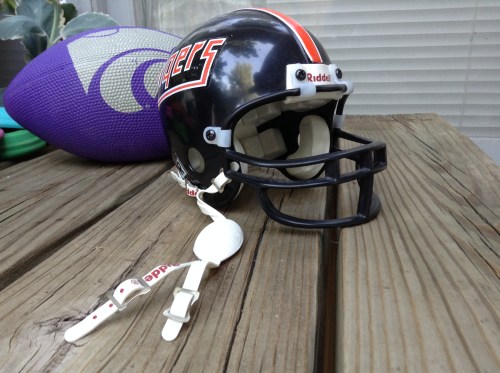
A couple of weeks ago they wore this helmet with logo.

oksthelmet1

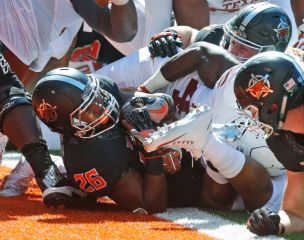
The week after, they wore this helmet with logo.

oksthelmet2

In their desire to be different, they lost who they are. In their drive to be hip and cool, they became forgettable. Who they are as a brand is no longer indelible in my psyche.

Sure, in recent history, the Oregon Ducks unis can be considered as flashy. It’s just they have sacrificed a vital part of their identification in order to be whacky with the uniforms. The association with a visual that instantly brings to mind high-powered, high-octane offenses snapping the ball every 12-15 seconds, doesn’t exist for me.

Looks at this:

longhorn

I’m not a huge fan of the Texas Longhorns but when I see their uniform and when I see their helmet and logo, I immediately think about Darrel Royal and the wishbone offense, John Mackovic and the upset of the vaunted Nebraska team in the first Big 12 Championship game, or Vince Young tip-toeing into the end zone to defeat USC in the BCS National Title Game in 2006.

That’s what a brand does. It “brands” your perception of a visual image to an association of  personal memories. That’s NOT what 47 different possible uniform combinations does.

What exactly is a brand and why is it important?

As a follower of marketing expert Seth Godin, I think his basic definition of a brand comes about as close to answering the above question as any other definition I’ve read.

“A brand is the set of expectations, memories, stories and relationships that, taken together, account for a consumer’s decision to choose one product or service over another.”

In short, having a recognizable brand pays off for your people for year after year after year.

So, please stop it!

Nike, Reebok, Adidas, Under Armor and all other apparel suppliers, help your clients with their brand, quit pushing sports programs to make your brand their brand. Last spring, I heard K-State color commentator, Stan Weber, say that Company X can’t wait for Bill Snyder to retire so they can roll out a whole line of alternate uniforms.  HEY, COMPANY X…DON”T! In fact, Company X…GO AWAY! Make shoes, sell apparel, get a stable of professional athletes to hawk your wares for you. Just stop this alternate uniform insanity.

Schools and sports programs, develop a brand and associate it with who you are as a program. Follow the lead of classics like:

Royals_images

chiefslogo

university_of_kansas_jayhawk_logo-svg

Be who you are by branding who you are.

Leave a comment

Filed under Coaching, Rants

#ThatSportsParent

One of the scourges of modern youth sports is out-of-line parents. The headlines are full of incidents involving overzealous parents. Odds are, each of us can pinpoint an incident of ugly parent behavior at a sports event no matter how small a town we live in. It’s threatening the very existence of youth sports and, more importantly, taking the FUN out of the game.

But when is it okay to get involved as a parent?

“So what happens when you’re the parent that yells for your own son (good but not the star) to sit so that a few of the others on the team can get some playing time because you’re up by 10 to a way lesser team? ”

Somebody I respect greatly asked me the above question a few weeks ago. It’s a tough question to answer, but I’ll give it a try. I’ll try to answer from a coach’s perspective and try to wall off my parental perspective because Lord knows, I’ve screwed up many times on that side of this issue. I’ve been there. I’ve felt the parental frustration seep its way into my competitive fire in less than positive ways.

So, here’s my personal philosophy on sports parenting and complaints.

First and foremost, a parent should be their kid’s biggest fan, not be their sports agent. There are truly legitimate situations in which a parent should intervene on behalf of their sports child. Physical, mental, or emotional abuse from either other players or from coaches should be reported immediately. In these situations, the parent needs to be the bulldog, the protector, and jump in and refuse to back down until a resolution is achieved.

But sports parents, listen up…Depth chart and playing time and play calling probably do not fall into this category of necessary parental intervention.

I’ve always felt there are three things every parent needs to do before they get involved. They are not easy to do. A parent needs patience and the ability to wall off emotion in this context.

  1. Observe the situation from an honest viewpoint.
  2. Be honest. This can be soooo hard, especially if you have those visions of your kid being the best thing since sliced bread. Step back and take an honest look at where your kid’s talent falls in respect to the other kids.
  3. Allow your kid to handle the simple situations. Have them find out from the coach or other players where they sit and develop a plan to get better.

My playing time thoughts depend on the level of play. If it’s a varsity high school level of competition, I believe in playing as few, or as many, players as necessary for the situation. We want to be highly competitive at the varsity level. We also want to balance player/program development, situational skills we may need to groom for later use, and get game reps with new plays or skills.

The developmental level of competition, middle school, freshman, junior varsity is where I like to play everyone as equally as possible during a game. Sure, the goal is still to win the contest, but we need EVERYONE in the program learning how to do their job in order to achieve success as a team. The game situation is where we can identify individual or team areas for improvement while gaining experience. The future, both the near future or the far future, carries a higher priority at the developmental level than winning or losing. (The developmental level is where many parents allow the basic purpose to slip away and the emotions to pressurize.)

Finally, there is the private or club sports environment. This area has grown by leaps and bounds over the past decade. My only advice right now for parents in these situations is as follows:

If you, as a parent, are unhappy with a club situation, whether playing time, depth chart, game management or practice management, then I suggest talking with your kid about the situation. If it bothers your kid and/or the other kids on the team, then schedule a meeting with the coach.

Schedule this meeting at a neutral emotion time (NOT before, after, or during a game, a practice, or in a public setting.). Meet with the goal being to solve the problem, not create new problems.

If you are unhappy with the outcomes of this meeting, I suggest moving to a new situation for the next season.

If you are unhappy seek a viable alternative or take advantage of alternative solutions that are presented to you. Don’t spread your misery. Sports are too much fun to be blanketed in this negativity.

Sports can teach kids a lot about life. Allow them to learn. Allow them to develop. Allow them to understand being part of the whole is better than trying to be the whole part.

Give them the opportunity.

most-annoying-sports-parents.jpg

Leave a comment

Filed under Rants

Your Purpose 4Q

Execution of purpose.

We’ve all heard the saying, “Practice makes perfect.”. Our parents, teachers, coaches, etc. have been telling us this little nugget of wisdom for years upon years, right? Well…it’s about as wrong as me watching the Olympic track & field competition and claiming I’m exercising.

Practice makes perfect ONLY if your practice goal is to be perfect. This means every repetition you perform—and skill development is ALL about repetition—must be done with a drive to improve. A drive to get just a little better each and every time.

We all go through the motions at times in our lives. It’s another slice of human nature. It’s just as easy to coast through practice as both a player and as a coach. This is particularly true as we approach the last third of a sports season and the routine gets…well, routine. As I said in the previous post, time is our biggest enemy. I think we can agree on that, don’t you?

THEN WHY DO WE COACHES WASTE SO MUCH TIME???!!!!

Sorry for shouting, but that wasting practice time thing is a pet peeve of mine. As a player, I hated the standing around doing nothing when there was a whole lot of talk happening and very little action. It drove me nuts back then and still drives me nuts as a 52-year-old.

Have your purpose. Have your plan. But most of all, have the drive and the ability to lead others toward the goal. A coach has to keep a practice session hopping. The average adult attention span (8 seconds) has now dipped below the average attention span of a goldfish (9 seconds). I could infer then that the hormone-driven teenage boy’s attention span would stand to pale in comparison to the goldfish. So if you are going to successfully deal with young athletes, you’d better plan on keeping things short and snappy.

Every season, every week, every day, every minute, every second need someone driving the bus in the right direction and at the right speed. THAT is another one of those unique characteristics of good coaches.

I am a firm believer in coaching fundamentals and drilling fundamentals. A technically sound player is a player you can depend on and build a team upon. There’s only one way to develop a technically sound player and that’s by working toward the goal of perfection with practice and repetition

In fact, you can even sneak this work in where the players don’t even realize they are working. During football practice, we used to do a 15-minute session at the start of practice with the kickers, long snappers, holders, and returners working on their skills. A good portion of the QBs, running backs, and receivers would be a part of this but very few linemen which left a big (both in sheer numbers and sheer size) part of the team watching.

Nobody likes to stand around and watch kickers kick, so we started this game where the linemen did a one-on-one pass drill. Coach Lane and I would be the quarterbacks, each with a line of lineman with us. The first guy in line would jump out and play defense and the second guy would be the receiver and run a pass route. The fifteen minutes would fly by. The Bubbas would really get into the competition, trying to score a reception on the offensive side or getting an interception or a pass breakup on the defensive end.

It was fun! The linemen would get the rare chance to touch the football, they would get a chance to talk trash and prove their skills in front of everyone. I also had fun slinging footballs in my best Kenny Stabler imitation.

But while all this was going on, nobody ever realized they were actually working. They worked on their footwork, they worked on their hand-fighting skills, and they learned how to establish leverage. I think anyone would agree those are all skills important to being a lineman. Also, they probably ran the equivalent of around a dozen or so sprints without complaint or without notice. In contrast, when we lined them up after practice to run a dozen sprints for conditioning, you should have heard the groaning and whining.

Bottom line: Execute your purpose and DON’T WASTE TIME.

In particular, don’t waste practice time. Maximize your purpose in your practice. Every single thing you do should be done for the purpose of getting better. There is no standing still in life or in sports. You are either getting better or going backward.

By the way, it’s too bad no video record exists of the quarterbacking skills of Coach Lane and myself. It was glorious. Not shabby for a couple offensive line coaches. Don’t laugh, I still have the sore arm to prove it…

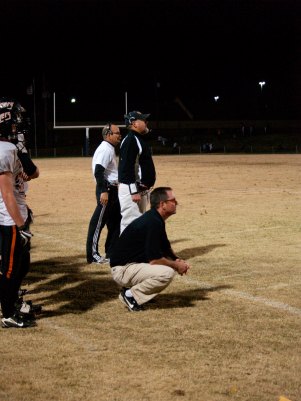
OLYMPUS DIGITAL CAMERA

There wasn’t a whole lot of executed purpose this night, but the picture with the Lane Brothers is one of my favorites and one of the few “action” shots I have.

Final Note: The “Your Purpose?” blog post began as a rant that grew and grew until it was beyond the scope of one post. It became a four post rant. Yowzers! But I’ve seen this problem of lack of purpose derail many teams and programs. Teams that I played on, teams I’ve coached, teams I’ve observed and teams I’ve been a fan of. It bugs the hell out of me, both in my own failures and observed failures. It seems so simple. It seems as simple as wearing pants before going out of the house. You wear pants when you leave the house, don’t you? Then why go “pantless” when you approach coaching?

Leave a comment

Filed under Coaching, Rants, Training

Your Purpose 3Q

Time.

We all fight it. We all struggle with it. It’s always moving and there never seems to be enough of it.

Double this sentiment for a sports coach. Time is our biggest enemy. Wasted time is a coach’s biggest regret. That is why we have to build a purpose of time into our greater purpose.

Okay, let’s say we want to win the football game against our rival next Friday night. We need to purpose our time properly. We need to develop a strategy that helps us achieve the vision. We watch scout film, both on our rivals past few games to determine how they approach a game and, just as important, our recent games to evaluate our mistakes. We need to organize and execute the practice preparation to get ready for the contest.  As you can see, every second matters.

Success is no accident or random occurrence.

Time is valuable. It is valuable to everyone. That is something I think we, as coaches, often fail miserably at. Kids have more legitimate time constraints now more than at any other time I can ever remember. Family responsibilities, church obligations, school obligations, extracurricular activities, work, hobbies, multiple sports commitments that demand time, especially in the summer.

As an effective leader working under today’s time constraints, you need to make the most of the time that you ask your players to commit. If you are going to ask them to come for summer conditioning every day at 6:30 AM, you damn well better send them home at 7:45-8:00 AM exhausted and drained so they feel like getting up a 6:30 AM was not a waste of their time. That responsibility is part of the unwritten trust contract I always felt was so important to establish between coach and player. We, as coaches, should be able to look the players in the eye after every practice or workout and say, “Today, I did not waste your time.”

Be able to fulfill that promise with a solid purpose of time day after day after day and you will have a team who will follow you to the ends of the earth. A team who will jump into the fire with you and compete with every fiber of their being. A team who will believe in your purpose and wrap themselves heart and soul with it. A team with complete trust in you as a coach; a trust that weaves its way through every member of the team.

  • THAT is the point of critical mass.
  • THAT is when the fun starts.
  • THAT is the magic of sports.

And it all starts with TIME.

Wooden_hourglass_3

Leave a comment

Filed under Coaching, Rants, Training

Your Purpose 2Q

“Great dreams aren’t just visions, they are visions coupled to strategies for making them real.” – Astro Teller, X (formerly Google X)

Early in my football coaching career, probably my second or third year, I did one of the most asinine things I ever did as a coach. It was the first week of summer conditioning. A good part of the CCCHS summer conditioning program was my baby. It was a huge responsibility. It was a responsibility I did not take lightly. It was my primary purpose.

I did the work. All year. Researched, read papers, visited K-State Strength Coach Rod Cole, watched videos, etc. ad nauseum to 99.99% of the population. I tried to put together the best program for our kids with the equipment we had or what could be scrounged up or made by the wizard-skills of Coach Lane. It was, a vision coupled with a strategy.

  • Our purpose was to physically hit the opponent like a cannon shot every, single play.
  • Our strategy was to develop the explosive power necessary to generate the force to hit the opponent hard every, single play. In a nutshell, F = ma.

So, the plan was set. We had a good start to the first week. The kids had listened well and picked up on the plan. Sure, there was whining and moaning and even some groaning, but if you’re a coach and you’re not getting some of that appropriately directed complaining, you may reevaluate how you are challenging your kids. I was feeling good. I was riding high.

We show up for the Thursday workout. 6:30 AM. We go through warm-ups. The kids come into the weight room, split off in their Bullets, Bricks, and Bubbas groups, and get to work. Next came the asinine, Coach Hays incident. It started with an innocent tap on my shoulder. I turn and there stands an innocent, young freshman holding a half-inch stack of dot-matrix printer paper and looking down at the ground to avoid all eye contact.

“Yes?” I ask the young man.

He pushes the stack of papers toward me and mutters, “My mom told me I need to do this workout.”

“Oh, really.”

“Yeah, she found it on the internet.”

I nod and take the papers. With the young man still standing there, I take one step forward and ceremoniously drop the internet-found road to athletic glory into the trash receptacle. I then address the bug-eyed, jaw dropped to his navel, freshman.

“Tell your mother where your workout ended up”

He had that distinct look of someone who was about to pee their pants.

“Also, tell her we know what we’re doing. Now go get to work.”

He released a slow sigh of relief, smiled, and joined his workout group. Not a word was heard on that issue again.

Take-home lesson:

  • Have a purpose that is backed up by a solid plan.
  • TRUST the plan.
  • SELL the plan to your people.

Also, don’t be a jackass in the process…unless it’s totally necessary.

Great dreams need a vision.

Plate

Note: That young freshman turned out a pretty damn good athlete in the long run—even without the collective intellect of internet weightlifting workouts. Excellent football player, state-caliber wrestler, all-around good (and ornery) guy, and very successful adult family man/businessman.

1 Comment

Filed under Coaching, Rants, Training

Your Purpose?

“Dreams aren’t just visions, they’re visions coupled to strategies for making them real.” -Astro Teller

Purpose sounds like something so, so simple. It seems like common sense to have a defined purpose when one takes on an endeavor. Especially in a sports endeavor, you would think approaching that sport with a purpose and a systematic plan would come natural, right? It seems purpose should be one of the necessities of sports coaching, don’t you think?

Truth is, it’s not.

Wanting to win is not a purpose. Everybody wants to win. It’s human nature to want to succeed; it’s written in our DNA. But what sets coaches and programs apart from one another often starts with purpose. Effort and hard work are essential but without a purpose effort and work are wasted.

I used to see this lack of purpose, or more accurately a lack of defined purpose, quite often in the coaching world. There are two types of purposeful coaches. The first are the ones who just copy or borrow a purpose. You see this type a lot at coaching clinics. They hear a talk or see a workout or scheme program and take it lock, stock, and barrel back to their kids and try to make their kids fit into it.

The other type of purposeful coach—the ones I think are generally more successful in their programs—take the same information as the first type of coach but they pick, choose, and mold those ideas to fit their athletes. They know their purpose and know how to mesh information to support their purpose.

In high school sports, a coach must lead with a purpose. Every day and with everything you ask kids to do must be done for a reason. You can’t throw a blanket idea out there expecting the kids to see the purpose and commit to it. That is not what a leader does.

A leader leads.

A leader has a defined purpose.

A defined purpose that is custom fit for his or her athletes.

A purpose that gives the athletes the best chance at success. A purpose they also can envision. A purpose they willingly dedicate themselves to attain.

Everybody wants to win. They just need guidance and need to be shown the way.

The answer is not simply in a book. The answer is not simply in a purchased training program. The answer is not what Coach X does at X College.

The answer is defining a purpose that your people can buy into. A purpose that does not waste their time and not wasting kids’ time is VERY IMPORTANT in today’s culture. A coach is competing with all kinds of pretty damn fun and cool alternatives to working your ass off for three hours a day every day, you better make your time with them worth THEIR time.

Whatever the endeavor, if you’re not happy with the results you are getting, try redefining your PURPOSE. You and your people may find you like the results.

Rings

Leave a comment

Filed under Coaching, Rants, Training

“Are you proud?”

I was doing my best to be a badass. It was working pretty good. Well, it was working well enough to keep second graders in line at their fine arts visit to the university. It was the class of second graders that my eldest daughter teaches. I walked across campus on a brisk, cloudy morning to help corral and keep the kids in line. A job right up my alley? Perhaps.

For you folks with no experience in the art of elementary school field trip duty, let me tell you a 30 minutes cello + piano concert is an amazing cultural opportunity for these kids, but…it is not the easiest thing to get an auditorium full of 8 & 9-year-olds to behave and listen to a 30-minute cello + piano recital. Not an easy thing at all.

The kids were awesome! They paid attention and listened; really listened to the music. I only had to pull out the Coach Hays death glare a couple of times and even had a productive discussion with the supposed “naughtiest” kid in the class who I had the pleasure to sit next to.

After the show, the class waited for their bus to arrive on the sidewalk outside the venue. Classic elementary school style of single file line order. My daughter leads the line and my job is to bring up the rear and not to lose any kids. The precision spacing and order of the line begins to break down as soon as we quit walking and start waiting. Kids start nervously moving around and telling “interesting” stories about their cat, their little brother, or their mother’s current boyfriend. Herding goats is actually easier to keeping these kids in alignment, but we survived.

A group of girls drifts back to the end of the line and the spokesperson of the group slides over until she is standing directly in front of me. She looks up with an angelic, second-grader face and asks, “Are Ms. Hays’s dad?”

“Yes.” I begin to wonder where this is going as the throng of girls collectively inch closer.

“Mr. Hays, are you proud of her?”

BANG!

I was stopped in my tracks. My badass failed me. My cold heart melted.

Yes. I am extremely proud of my kids. One teacher and, in a week, two college graduates. I am beyond proud the way they’ve started their lives outside the nest.

“Yes, I am.” was my simple answer. Three words that easily could have blown up into a thousand words (and possibly with colorful language not appropriate for second-grade ears). The little girl’s face lit up and her smile almost made me break down in tears. The bus soon came and I said goodbye to all my second-grade friends.

As I walked across campus a proud dad, I hoped each of the little girls, and the rest of the kids in the class, had someone in their life to be proud of them. I wished the people in these kid’s lives appreciated their potential and will help them grow into something they can take great pride in.

It’s a great feeling having kids turning into adults, especially when they are turning into much better adults than their “badass” old man.

It feels kind of like…

WorldSeriesTrophyKSU

Every single day.


Leave a comment

Filed under Rants, Writes

Socialing

Athletes are, and should be, held to a higher standard. It is a price to be paid for the opportunity to participate. You, as an athlete, a coach, or a fan, owe the game much, much more than the game will ever owe you. As Coach Lane used to say, “Faith, family, and football is a game we are fortunate enough to be able to play.”

There are few areas where the modern athletes, especially the young, high school athlete, must hold themselves accountable to a higher standard than in the realm of social media. The ability to send our thoughts and ideas into the public realm is greater than it has ever been in the history of mankind. It’s instantaneous. It’s far-reaching. It can be a slippery slope.

Social media is great because it connects us like we have never been connected before and gives us an audience. Social media is bad because it connects us like we have never been connected before and gives us an audience. In short, social media is a double-edged sword. It can been used in a positive manner as easily as it can be used as a negative.

Parents, coaches and administrators need to develop a social media plan and convince players and teammates to abide by the plan. Creating the best tribe possible should be the underlying goal of everything we do as coaches and athletes. Social media is part of being in the tribe. Three things to remember about being a good tribe teammate.

  • What is good for the tribe is good for you too.
  • The jabs you take at the tribe are as damaging and as senseless as punching your own self.
  • Impact your tribe positively with your actions. In Coach Hays words, don’t crap in your own nest.

Social media is permanent. Your post is given a life. Your friends and followers see it. They like it or share it and your post is opened up to all the friends and followers of your friends and followers. The social reach can be extended to layer upon layer upon layer—even if you deleted your original post 30 seconds after posting it. Social media has permanence.

A good guidepost for social media, which is also a good guidepost for general life, is to not say anything to someone on social media or about someone on social media that you would not say if you were standing face to face to them.

Be true.

Be honest.

Be real.

But do it while playing nice.

Use your social media spectrum for good. The Mrs. Coach Hays, in her infinite wisdom on such matters dealing with young people, often reminds me of the credo, “Positive in public, negative on your own time.”

Be who you are, but put your best face toward the rest of humanity.

Finally, as the venerable Coach Melvin Cales used to tell his son and my college roommate, Monty, after Sunday visits to our college town where Coach Cales’s mother lived, “Don’t do anything you wouldn’t want your grandmother to read about in the paper.”

A great lesson to guide your social footprint.

And a great life lesson to boot.

Social wise, my friends. 

Socialmedia-pm

By Ibrahim.ID [CC BY-SA 4.0 (http://creativecommons.org/licenses/by-sa/4.0)%5D, via Wikimedia Commons

Leave a comment

Filed under Coaching, Rants

Under Your Skin

(This is my 350th post on The Coach Hays blog since I first started this dog and pony show in 2009. To celebrate, I thought a proper rant would be fitting. Thanks for reading and I hope I can keep going for at least 350 more.)

What makes a good athlete? What makes a team successful?

It’s about commitment. It’s about grinding through the work and the repetition. It’s the footwork drills. It’s the extra swings. It’s taking the shots after practice or perfecting your jump technique.

It’s going beyond what the practice and game plans say you should do. It is going beyond what your supporters say and further than your biggest detractors could ever dream was possible.

It’s the competitor’s mark to be permanently worn under your skin.

It’s a mark you wear with pride. As an individual. As a competitor. As a group. As a team. As a family.

  • Not a hashtag.
  • Not a poster hanging on the wall.
  • Not a program t-shirt.

The mark of a winner is burned on your heart. It seeps into every nook and cranny of your competitor spirit.

You do the work necessary. And then you do it again.

Look in the mirror. What do you see? If you don’t like the results you are reaping, look at what you are sowing.

  • Are you putting in the work? Input = Output.
  • Are you blaming instead of improving?
  • Talking instead of performing?
  • Whining instead of winning?

If you don’t like where you’re at, then take the steps to move forward. Sow the good seed.

Ask yourself, “Am I along for the ride or am I going to put this team on my shoulders and rise to the top?”

Commit. Improve. Do the work.

Hard work is the magic.

Wear the mark of a competitor. Decide if your mark is a temporary tattoo or if is it written in your marrow.

Be dependable. Be consistent. Be a rock.

Wear your commitment under your skin. As I’ve said before, Be Indelible.

Permanent and unshakeable. 

TLWtattoo

Photo used with permission. #TLW13

Leave a comment

Filed under Coaching, Rants, Training